Rune of Khaldun
| Rune of Khaldun | |||||||||||||||
| the Rune of Khaldun · Khaldun maker's mark · the Khaldun rune · the Forgehold mark | |||||||||||||||
 | |||||||||||||||
| Item | |||||||||||||||
| |||||||||||||||
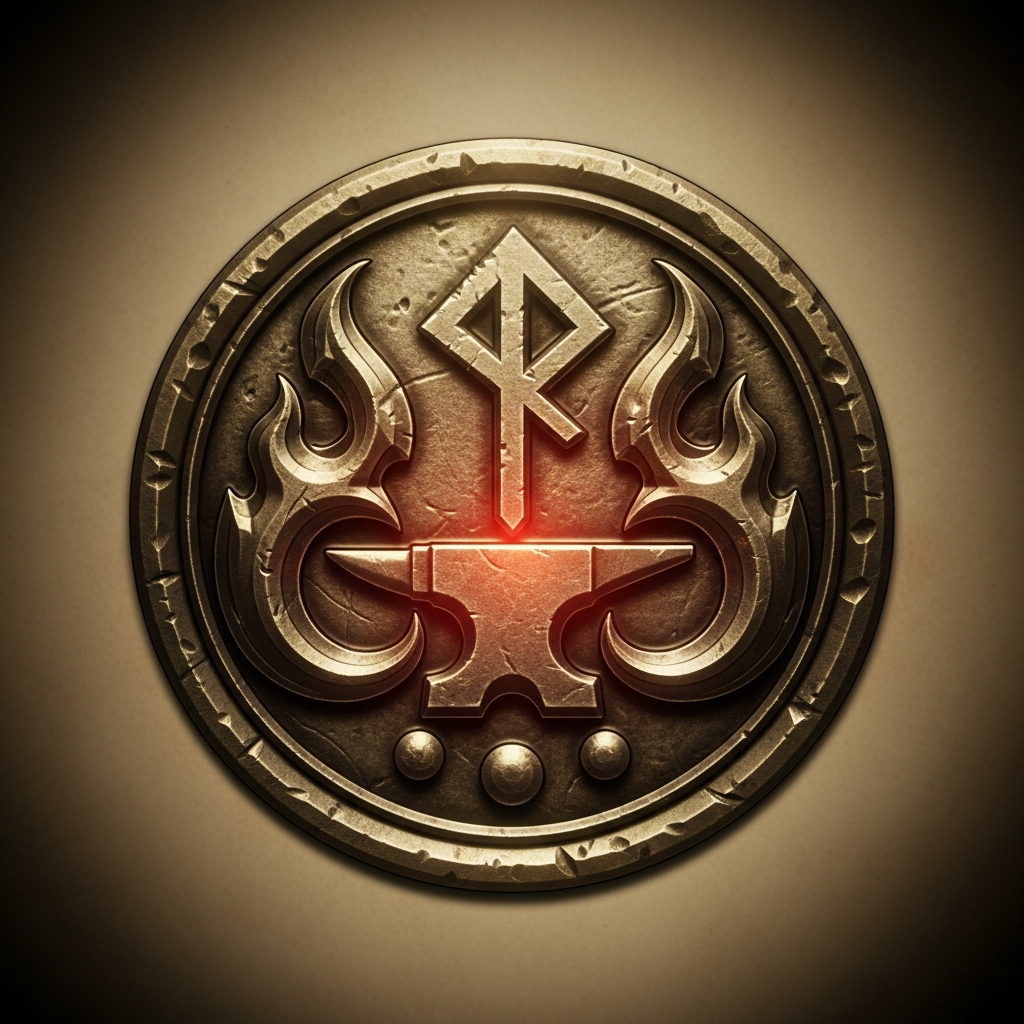
The Rune of Khaldun is the maker’s mark stamped on weapons and armour forged in the Everflame Forges of Khaldun Forgehold — the Embermantle Clan’s and the Great Guilds’ seal of unmatched quality. The world brief is specific: gear bearing the rune commands triple the price in any city above. The mark is the commercial spine of Khaldun’s economy and the basis of the city’s continental reputation; it is also one of the visible answers to “what makes Khaldun-craft worth the Emberpeak journey.” The brief does not describe the rune’s appearance, location-on-piece, or anti-forgery features; it describes only the mark’s effect on price. World-brief canon; the party has not handled a Rune-of-Khaldun-stamped piece on screen, and the closest the campaign has come to a Khaldun craft-product is Vasquez’s Aurelian plate re-engraved with his adoptive dwarven family’s crest — Khaldun-adjacent in iconography, but Aurelian-forged.
Overview
The Rune of Khaldun is the maker’s mark stamped on weapons and armour forged in the Everflame Forges of Khaldun Forgehold. It is the Embermantle Clan’s and the Great Guilds’ seal of unmatched quality, and the visible signature that lets a Khaldun product trade at its Khaldun price across Eldurae.
The world brief’s single load-bearing claim about the rune is the price effect: gear bearing the Rune of Khaldun commands triple the price in any city above. That sentence carries the whole economic argument for the Forgehold: Khaldun’s output sells at a tripled multiplier on the strength of the mark.
The party has not handled a Rune-of-Khaldun-stamped piece on screen.
What the rune does (commercially)
The rune does one thing in the brief: it triples the price.
The construction is precise. The mark commands triple the price — not “a premium,” not “the best price.” And the comparison is “in any city above” — not “in Khaldun,” not “in nearby markets,” but in any of the great cities sitting on the surface above the Emberpeaks. The rune is the cross-city portable signal that a piece is Khaldun-made.
The implication chain:
- Khaldun does not undersell its own gear at home. The triple-price multiplier is on the surface market, which means the city’s domestic price is the baseline.
- The mark is the recognition mechanism that survives translation. A piece bearing the Rune of Khaldun arriving in Velkris or Aurelia or Arcanthys is recognised as Khaldun-made by the rune itself, not by paperwork or seller reputation.
- Forging the rune would be the business of any non-Khaldun forge trying to sell at the multiplier. The brief does not describe anti-forgery features, but the existence of the price differential creates the obvious incentive. Whether the rune is technically reproducible by a non-Khaldun rune-smith — and what the Flameguard do to anyone caught doing so — is unspecified.
What the rune does (mechanically)
The world brief does not say.
The rune is described only as a maker’s mark and a price signal. It is not described as adding magical effect to the gear, and it is not described as the enchantment rune (that work is done in the Runeworks by the Guild of Rune-Smiths, applied to a subset of forged pieces, and is a separate craft). A non-enchanted Khaldun blade may bear the Rune of Khaldun; an enchanted Khaldun blade bears the Rune of Khaldun and its Runeworks binding.
Whether the rune confers a non-magical mechanical benefit (advantage on Strength checks to use the weapon? superior hardness? heat resistance?) is unspecified. The brief’s silence is probably deliberate: the rune is, in the world’s commercial reality, a trust signal. The buyer pays triple because the buyer trusts the Khaldun forge — not because the mark itself is magical.
This is a different category from the Nullstone-runework on the Aurelian plate Vasquez wears: those runes do something mechanical (advantage on saves vs arcane spells, blocking the wearer’s own arcane casting and rage). The Rune of Khaldun, by contrast, is descriptive of the maker, not of an embedded effect.
Where the rune lives
The brief does not say where on a piece the rune is stamped — pommel, blade-fuller, breastplate, vambrace, the inside of a helm — and it does not describe what the rune looks like. The natural inference is that the rune is visible (it is the recognition signal) and non-removable without obvious damage (its commercial function depends on integrity). Whether it is stamped at the cooling stage of the forge, etched after polish, or inscribed by the Guild of Rune-Smiths as a separate post-forge step is unspecified.
Who can stamp it
The authority to apply the rune is, structurally, the Embermantle Clan’s — running through the Guild of Smiths on standard goods, and through the Guild of Rune-Smiths on enchanted goods. The brief does not name a specific office responsible for the stamp. The probable structure (consistent with the brief’s “every child must follow one [apprenticeship path]” line) is that the right to stamp the rune is the senior-craft privilege at the end of a Guild apprenticeship — a Khaldun smith earns the stamp the way a master craftsman earns a hallmark in an above-ground guild city.
In-campaign references
The Rune of Khaldun does not appear on screen. The closest the party has come to a Khaldun stamp of any kind is the dwarven family crest Vasquez re-engraved onto the chest of his looted Aurelian plate in s10 [2], L1841). That crest is his adoptive family’s, Khaldun-adjacent, but it is not a Khaldun maker’s mark — the plate itself is Aurelian-forged, not Khaldun-made.
The party’s loot ledger contains no Rune-of-Khaldun-stamped piece as of s16.
Posture toward the party
No interaction. If a future arc brings the party to Khaldun, the rune is the visible signal they will be paying triple to acquire. The economic incentive to engage Khaldun on a commercial footing — and the disincentive against doing so quietly, given the Flameguard’s standing order on rogue magic — both run through the same mark.
Status as of session 16
Off-screen. The rune continues to be stamped on Khaldun-made gear by the authority of Thane Durak Embermantle and the Great Guilds of Khaldun. No piece bearing the rune is in the party’s possession.
See also
- Khaldun Forgehold
- Everflame Forges
- Runeworks
- Emberite
- Embermantle Clan
- Great Guilds of Khaldun
- Thane Durak Embermantle
- Emberpeak Mountains
- Aurelian Plate Armour with Nullstone Runes