Vhal'Zarim
| Vhal'Zarim | |||||||||
| Valzerum · Valzerine · Valhasmin · Malzorim · the Bastion of the Platinum Flame · Bastion of the Platinum Flame | |||||||||
 | |||||||||
| Location | |||||||||
| |||||||||
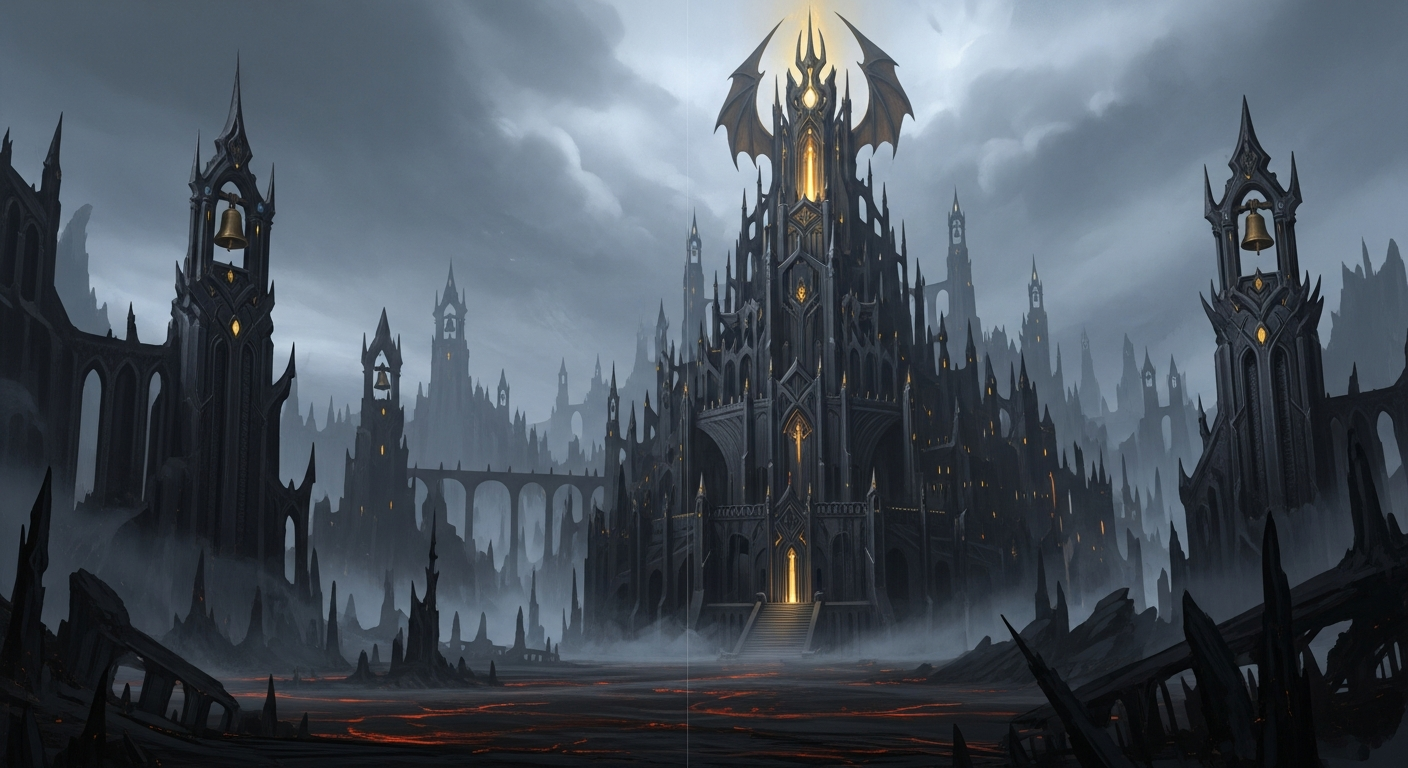
Vhal’Zarim, the Bastion of the Platinum Flame, is the cathedral-fortress of Bahamut raised from the dragon-scorched ruin of the dead empire of Karvos. World-brief canon. Black stone towers rise from scorched earth and the air tastes of ash and incense; the silence is heavy not out of fear but devotion. Every citizen swears an oath to the Platinum Flame, every soul is bound to the will of the Church, and the day begins and ends with the tolling of sanctified bells from the Sanctuary of Flame — the city’s immense central cathedral, where Bahamut’s eternal fire burns behind sealed doors. Magic exists only in service of the divine; metallic-blooded sorcerers are exalted, chromatic ones vanish, and arcane study is permitted only under the eye of the Platinum Order. Caelumn is from Vhal’Zarim, of draconic ancestry tied to Bahamut’s flame (exact dragon type unresolved per DM ruling), and his s9 succubus-vision was set at the Platinum Order [1]. In s18 Caelumn delivered the campaign’s first full backstory window on the city [16]: he placed it at “the very south of the continent,” named the chromatic-dragon attack as its founding wound and Bahamut’s intervention as the moment of salvation (“when the gods abandoned us, Bahamut was the one, the only one who came to our aid”), and gave the eschatology its first explicit line (“when I die, I shall be burnt forever” — the eternal flame, not a promised land). The Platinum Order tolerates other religions “as long as they’re not within our city walls” [9]. Per Thomas Feld [3], Vhal’Zarim and Aurelia hunted the chromatic dragons together “to near extinction” — a campaign-level constraint on The Egg Quest. The party has not visited.
Overview
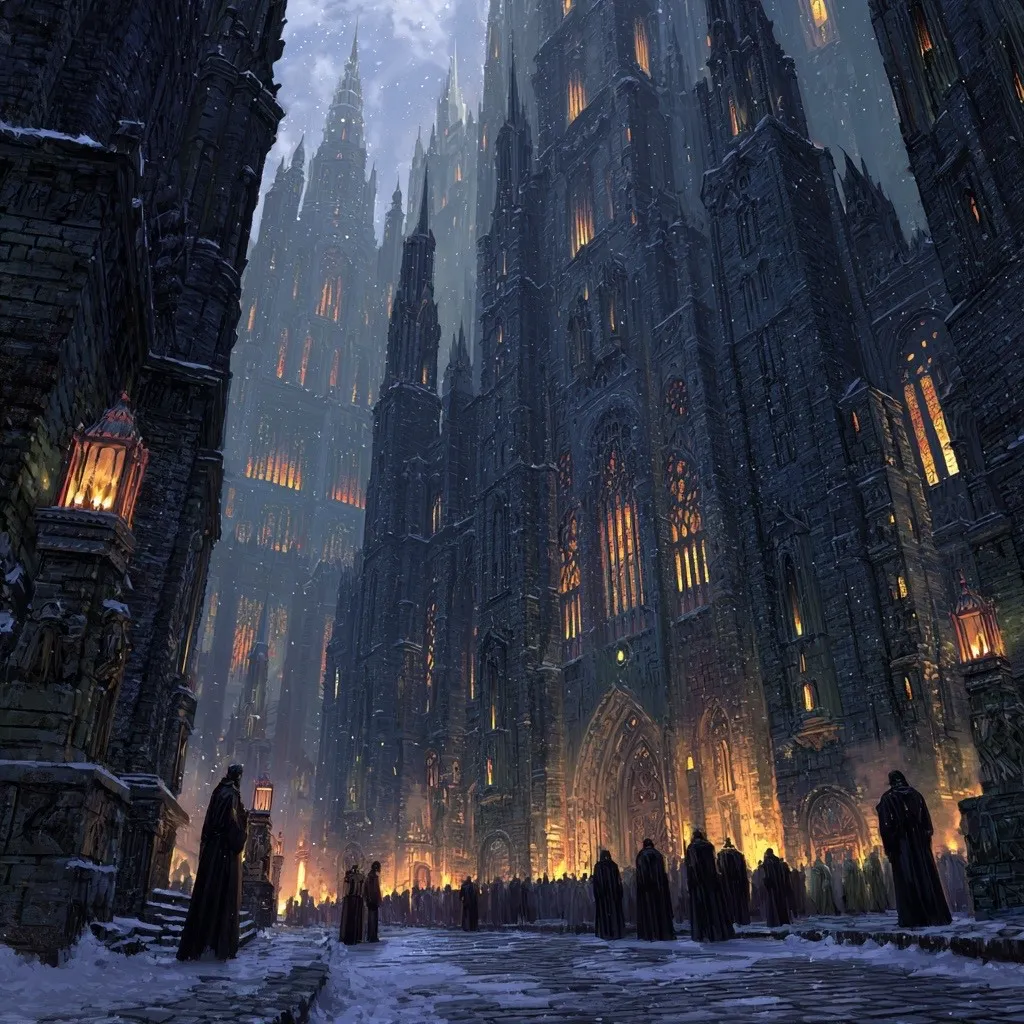
Vhal’Zarim is not a city. It is a cathedral carved into the bones of a dead empire. The world brief is explicit on the point: black stone towers rise from scorched earth, their spires clawing at the heavens like the remnants of a holy war; the air tastes of ash and incense; the silence is heavy not out of fear, but out of devotion. Even whispers in Vhal’Zarim are prayers. The city was built in the crater where the empire of Karvos once stood, and the faithful say that Bahamut himself descended upon that place after thirteen days of wrath from chromatic dragons, shielding the last survivors beneath his wings. What rose from the ruin was not a city — it was a covenant.
The party has not visited. Two indirect threads tie Vhal’Zarim to the campaign: it is the home city of Caelumn, who was raised by the Platinum Order and walked away unworthy by his own admission [11]; and it is one of the two institutions named by Thomas Feld in session 11 as having hunted the chromatic dragons “to near extinction” alongside Aurelia [12] — a setting fact with direct bearing on Sevryn’s Egg Quest.
Geography and appearance
Vhal’Zarim is a black-stone cathedral-city — towers of dark sanctified stone rising from a crater of scorched earth. The architectural register is martial-devotional rather than civic: spires rather than streets, sanctified halls rather than markets, cloisters and processionals rather than plazas. The brief describes the air itself as carrying ash and incense — the ash a residue of the dragon-fire that levelled Karvos, the incense the sustained ritual signature of the present-day cathedral.
At the centre of the city stands the Sanctuary of Flame, the immense central cathedral where the eternal fire of Bahamut burns behind sealed doors. The Sanctuary’s bells mark the city’s daily rhythm: every day begins and ends with their sanctified tolling, audible across the whole of Vhal’Zarim.
History
The fall of Karvos
Before Vhal’Zarim, the crater on which it stands was the imperial seat of Karvos — a dead empire of the pre-Bahamut era. Karvos was scoured from the world in thirteen days of chromatic-dragon wrath. The faithful of the present-day city say that on the thirteenth day Bahamut himself descended, shielding the last survivors beneath his wings; the empire was lost, but the survivors became the seed of the cathedral-city that followed.
This is the founding event of Vhal’Zarim. The chromatic-dragon-killing posture of the modern Platinum Order — the body of clergy and scholar-knights that runs the city — is, in narrative terms, the continuation of that founding wound.
The chromatic-dragon hunt (joint with Aurelia)
Thomas Feld, an orchard farmer met by the party on the road between Umbrafall and Eldwythe in session 11, delivered the campaign’s only direct historical statement on Vhal’Zarim’s signature work. Asked by Caelumn what Aurelia had done “with the dragons back in the day”, the DM lifted the answer from in-fiction rumour into explicit canon:
“So you would know that they hunted, together with Malzorim, hunted pretty much all chromatic dragons to near extinction and at this point it’s rare to find any chromatic dragons which is why your quest is so hard.” — Nick (DM), [3]
“Malzorim” is the Whisper-transcription mangling of Vhal’Zarim; the cite is the campaign-canonical confirmation that Vhal’Zarim and Aurelia shared the chromatic-dragon hunt as a long-standing joint policy. The implication is structural: the two of Eldurae’s great powers most ostensibly opposed in temperament — Aurelia’s anti-magic divine theocracy and Vhal’Zarim’s Bahamut-clergy — were aligned operationally on draconic policy, and have been for long enough for their work to have “near-extinguished” chromatic dragons on this side of the continent.
The line is load-bearing for The Egg Quest: Sevryn’s recruitment premise rests on chromatic-dragon-related work, and the near-extinction baseline implies the quest may be functionally unworkable here without travel beyond the continent. Hugo’s on-the-spot reaction in s11 was to stow his dragon-skull helmet rather than be seen wearing one [13] — the party’s clearest operational acknowledgement that Vhal’Zarim’s posture, transmitted via Aurelian rumour, was now a threat surface to be navigated.
Faith and law
Every citizen of Vhal’Zarim swears an oath to the Platinum Flame. Every soul is bound to the will of the Church. The Sanctuary of Flame’s bells mark the daily rhythm of devotion that runs through every layer of public life.
Magic exists only in service of the divine. The line between exalted and vanished is the brief’s most precise institutional fact:
- Metallic-blooded sorcerers — gold, silver, brass, copper, bronze — are exalted in Vhal’Zarim.
- Chromatic-blooded sorcerers — red, blue, black, green, white — vanish.
- Arcane study is permitted, but only under the eye of the Platinum Order.
The Order is the institutional eye on all permitted arcane work in the city. The brief does not enumerate ranks, titles, or procedures of that oversight — the canonical shape of it is what it gates: arcane legitimacy, sanctioned scholarship, and the line between the exalted and the disappeared.
Government / control
The Platinum Order — the Bahamut-aligned clergy and scholar-knighthood. Vhal’Zarim has no civic government distinct from the Order; the city and its Church are the same institution at different focal lengths. The Order’s foundational work is the chromatic-dragon hunt outlined above; its present-day work is the oath of the Platinum Flame, the gating of arcane study, and the maintenance of the eternal fire at the Sanctuary of Flame.
Notable features
- Sanctuary of Flame — the city’s immense central cathedral. Behind its sealed doors burns Bahamut’s eternal fire. Its sanctified bells open and close every day in the city. (Unvisited; world-brief detail only.)
Reputation
Outsiders speak of Vhal’Zarim with awe and unease in equal measure. There is no crime, no hunger, no chaos — and equally no freedom. The people live in orderly devotion, their eyes fixed on a god who once saved them and who they believe may one day return. The brief is precise about the texture of the surface: silence as devotion, order as covenant, austerity as evidence of fidelity rather than privation.
In-campaign references
Session 9 — Caelumn’s failure-vision
In the Black Vein Quarry succubus-vision sequence, Caelumn described his greatest failure as a Platinum Order initiate who could never live up to his ancient draconic blood. The framing names the Order — and by implication Vhal’Zarim itself — as the institution that raised him:
“Callum was taken in by the platinum order, um, when he was young, because they had a vision that he would have, well, he had very ancient powerful draconic blood. Um, and, But throughout his entire time there, he could never actually reach that power. He could never reach anybody’s expectations. He was always behind everybody else within the Order.” — Caelumn, [14]
The succubus pressed: “You are unworthy. You are not worth the time. A failure to your land and your race” [15]. The Wisdom save to dispel the vision failed; the failure-vision is now part of Caelumn’s canonical backstory. The campaign’s working interpretation, per Caelumn’s wiki entry, is that he is a former or rejected initiate — on leave or in self-imposed exile from the city, with one named mentor still backing him offstage. The chromatic-fire flavour of his actual spell list (Firebolt, Produce Flame, Fireball, Chromatic Orb) sits structurally awkwardly with Vhal’Zarim’s exalted-metallic / vanished-chromatic posture, an unresolved character contradiction that the s11 chromatic-dragon-extinction reveal has only sharpened.
Session 11 — Thomas Feld and the chromatic-dragon hunt
The cite is treated in full under History → The chromatic-dragon hunt above. In short: Thomas Feld volunteered “there’s something wrong about Aurelia. And I don’t quite like what they did with those dragons back in the day” [2], and the DM elevated the follow-up into canon — Vhal’Zarim (“Malzorim”) and Aurelia hunted the chromatic dragons together “to near extinction” [3].
Session 18 — Caelumn’s full backstory dump
Around the fire at the Aurelian-coast farming cottage after the catfish swim, Mike asked Caelumn how he had cast Cure Wounds during the open-ocean swim. The conversation opened the longest backstory window of Caelumn’s run so far [16], and it is the first on-screen first-person account of Vhal’Zarim from one of its own. The Whisper transcript variously renders the city’s name as “Valsarim”, “Valzarim”, and “Velzarim”; the canonical spelling is Vhal’Zarim.
Cleric training. Caelumn confirmed his Cure Wounds and other cleric-list spells came from “cleric training due to my time in the clergy” [4]. When Mike pressed on whether he had been an initiate who dropped out, Caelumn deflected: “that is like the basic training uh for where i’m where i’m from well i’m not really an initiate i suppose” [17]. The s9 succubus-vision’s “former or rejected initiate” reading is consistent with this s18 self-account but Caelumn declined to put a specific label on his position. He treats clerical-basic-training as something every citizen of Vhal’Zarim receives.
Geographic placement. Caelumn placed Vhal’Zarim explicitly at “the very south of the continent” [6], in opposition to Mike’s home city Arcanthys “in the very north.” This is the first on-screen geographic anchoring of the city; the world-brief did not previously fix its compass position relative to other Six Powers cities.
The chromatic-dragon attack myth. Caelumn delivered the city’s founding story as he was raised on it:
“long ago our city was attacked by the chromatic dragons and the great one, the platinum dragon came down and saved us and he may not be something that you would revere but when the gods abandoned us Bahamut was the one, the only one who came to our aid and now we live in eternal gratitude towards him” — Caelumn, [6]
The myth as Caelumn carries it foregrounds abandonment by the rest of the pantheon followed by Bahamut alone answering — narratively distinct from the world-brief’s “thirteen days of chromatic-dragon wrath, Bahamut shielded the last survivors beneath his wings” framing. The two accounts are compatible (Caelumn’s is the in-character devotional gloss; the brief is the historical summary) but the in-character emphasis on divine abandonment rather than divine intervention is the new colour from s18.
Nick (DM) confirmed in the same exchange that Bahamut is “very much a god” in Eldurae, not merely a regional myth [8]. Mike pressed on whether the platinum dragon was actually a god or just locally venerated; the DM ruled the city’s worship is theologically real.
Tone. Caelumn offered the table a real-world handle on Vhal’Zarim’s devotional intensity:
“if you know like Warhammer 40k lore everyone’s like super divine to the emperor […] that’s the kind of place it is […] it’s like a super religious zealotry, basically” — Caelumn, [7]
This is player-side characterisation, not in-fiction canon doctrine. Caelumn’s framing is consistent with the world-brief’s “no crime, no hunger, no chaos — and equally no freedom” reputation paragraph, but the W40k-Emperor-cult comparison is a PC reading rather than a DM ruling. Future agents: treat Vhal’Zarim as a high-intensity theocratic cathedral city per Caelumn’s self-account, but do not over-canonise the specific Warhammer analogy.
The Platinum Order’s policy of religious tolerance — outside the walls. Caelumn named the order he belongs to for the first time in-fiction (the Platinum Order had previously been named only in the world-brief, in his s9 succubus-vision, and in derived wiki articles):
“We of the Platinum Order don’t judge other people […] The Platinum Order is accepting of all religions, as long as they’re not within our city walls.” — Caelumn, [9]
The policy is a soft-doctrine analogue of the world-brief’s “vanished chromatic-blooded sorcerers” institutional fact: tolerance abroad, exclusivity within. Caelumn’s tonal delivery was deadpan-orthodox; Mike’s read-back at [18] — “get up all religions as long as you get the fuck out of our city” — caught the order’s working register precisely.
Eternal-flame eschatology. Terry asked Caelumn if Bahamut promised a Promised Land. Caelumn’s answer:
“No, I am just awaiting seeing the eternal flame. And when I die, I shall be burnt forever.” — Caelumn, [10]
This is the first explicit Vhal’Zarim eschatology in the corpus: no afterlife paradise; the faithful are returned to the flame. The phrasing “burnt forever” reads to Mike as bad (“you see, that sounds bad”, [10] but Caelumn delivered it as the answer of a person who finds the prospect entirely satisfying. The eternal flame is presumably linked to the Sanctuary of Flame’s sealed-doors fire at the city centre. The eschatology now sits next to Aurelia’s Pure Light system as a distinct Bahamut-faith soteriology — separate religious systems, per the post-s17 DM corrections register.
Caelumn’s draconic ancestry. The s9 succubus-vision had Caelumn carrying “very ancient powerful draconic blood.” The post-s17 DM corrections register pinned this as tied to Bahamut’s flame, exact dragon type unresolved — do not confirm red. Session 18’s backstory dump reinforces the Bahamut tie (Caelumn’s whole devotional life is structured around the Platinum Dragon) without specifying the dragon-blood type. Hugo’s [19] observation that Aurelia kills dragons on sight, and the DM’s clarification at L1814 that metallic dragons are considered holy while chromatic dragons are seen as a perversion of draconic energy, leaves Caelumn’s draconic lineage placed in the metallic / Bahamut-aligned tier by orthodoxy if not by visible spell flavour. Caelumn’s spell list (Firebolt, Produce Flame, Fireball, Chromatic Orb) remains structurally awkward against the city’s official posture; that contradiction is unresolved.
Status as of session 18
Unvisited. The party is currently inland on the road from the Aurelian coast toward the White Lantern Shrine in pursuit of The Egg; Vhal’Zarim is not on their travel path. Caelumn’s potential return-home arc remains open and unaddressed in-fiction, but his s18 backstory dump has now made his Vhal’Zarim identity a load-bearing part of his on-screen character voice. The Platinum Order’s role in the chromatic-dragon hunt is a campaign-level constraint on The Egg Quest but has not been re-engaged on-screen since s11. The eternal-flame eschatology, the chromatic-dragon attack myth, and the Platinum Order’s “tolerance outside the walls” policy are all now on the record from a Vhal’Zarim insider’s mouth.
See also
References
- ^ Session 9, line 1190-1195 — Caelumn's failure-vision at the Platinum Order.
- ^ Session 11, line 850 — Thomas Feld — "I don't quite like what they did with those dragons back in the day".
- ^ Session 11, line 852 — DM canon — Aurelia and "Malzorim" (Vhal'Zarim) hunted all chromatic dragons to near extinction.
- ^ Session 18, line 1724 — Caelumn confirms his cleric training: "I have cleric training due to my time in the clergy".
- ^ Session 18, line 1730 — Caelumn names the city as his home and frames it: "I'm from Valsarim... it is a cathedral city. So, and we all praise the Platinum Dragon there.".
- ^ Session 18, line 1750 — Caelumn delivers the chromatic-dragon attack origin myth and geographic placement: "very south of the continent... long ago our city was attacked by the chromatic dragons and the great one, the platinum dragon came down and saved us... when the gods abandoned us, Bahamut was the one, the only one who came to our aid, and now we live in eternal gratitude towards him".
- ^ Session 18, line 1754 — Caelumn characterises the city's tone via Warhammer 40k Emperor-worship analogy: "everyone's like super divine to the emperor... super religious zealotry" (PC characterisation, not DM canon).
- ^ Session 18, line 1757 — DM confirms Bahamut is "very much a god" in this setting, not just a city myth.
- ^ Session 18, line 1789 — Caelumn states the Platinum Order's tolerance policy: "The Platinum Order is accepting of all religions, as long as they're not within our city walls".
- ^ Session 18, line 1800 — Caelumn delivers the eternal-flame eschatology in response to Terry's Promised-Land question: "No, I am just awaiting seeing the eternal flame. And when I die, I shall be burnt forever".
- ^ Session 9, line 1190-1192 — Inline citation.
- ^ Session 11, line 850-852 — Inline citation.
- ^ Session 11, line 853 — Inline citation.
- ^ Session 9, line 1190 — Inline citation.
- ^ Session 9, line 1195 — Inline citation.
- ^ Session 18, line 1724-1800 — Inline citation.
- ^ Session 18, line 1731 — Inline citation.
- ^ Session 18, line 1791 — Inline citation.
- ^ Session 18, line 1812 — Inline citation.