Runeworks
| Runeworks | |||||||||||||||||
| the Runeworks · Khaldun Runeworks · the Runeworks of Khaldun · the enchanted-weapon workshop | |||||||||||||||||
 | |||||||||||||||||
| Location | |||||||||||||||||
| |||||||||||||||||
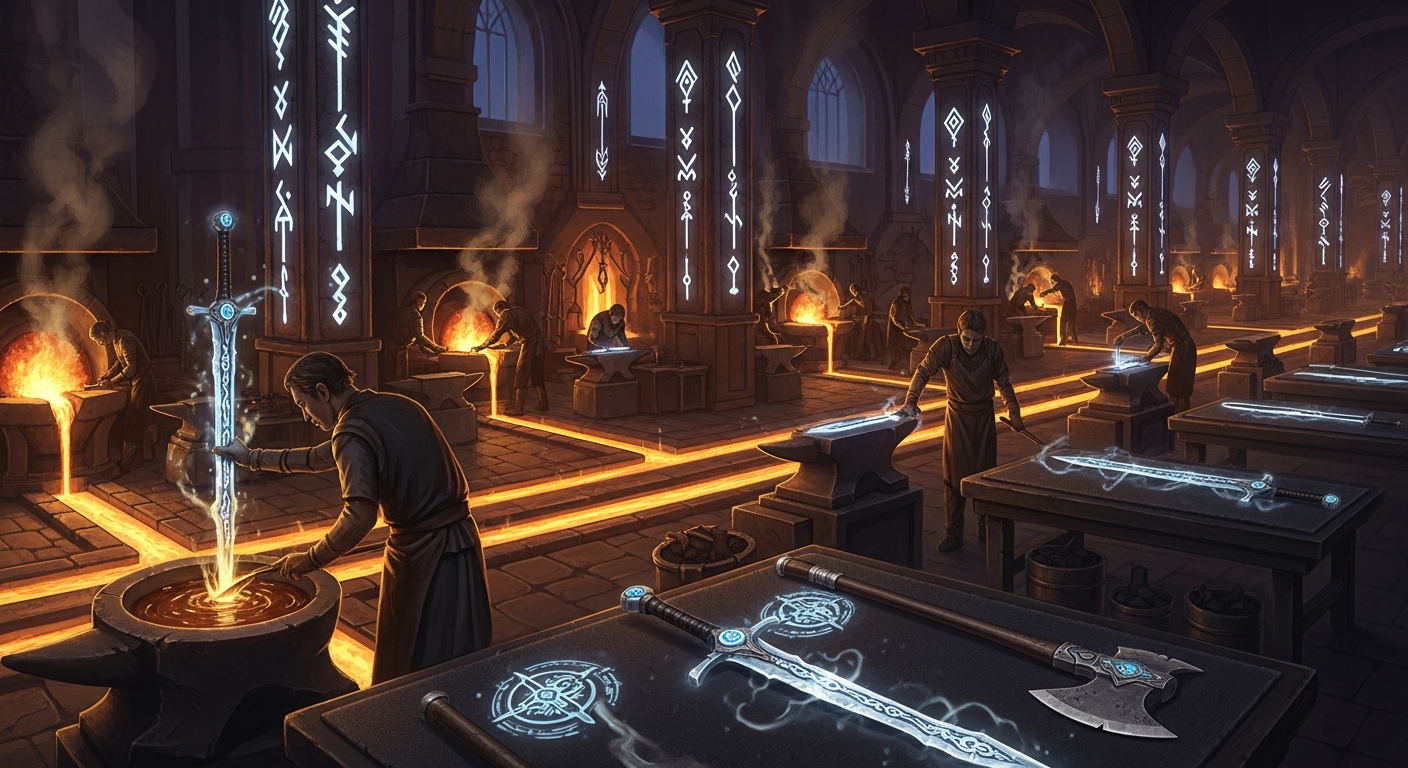
The Runeworks are the enchanted-weapon workshop of Khaldun Forgehold — the production hall of the Guild of Rune-Smiths within the Great Guilds of Khaldun and the institutional answer to the city’s policy of “magic only when it serves the forge.” The world brief gives one dense sentence on method: runesmiths whisper secrets of binding and warding into hot steel before quenching it in blessed oil. The output is enchanted weapons — the smaller and more exclusive end of Khaldun’s craft pipeline, fed by Everflame-fired steel from the Everflame Forges and stamped with the Rune of Khaldun maker’s mark. The Runeworks are the visible proof that Khaldun’s anti-rogue-caster posture is utilitarian, not theological: enchantment that serves the forge is celebrated; enchantment that does not is silenced by the Flameguard. World-brief canon; the party has never visited.
Overview
The Runeworks are the enchanted-weapon workshop of Khaldun Forgehold — the production hall in which Khaldun’s hottest steel is turned into the city’s enchanted gear. They are operated by the Guild of Rune-Smiths within the Great Guilds of Khaldun, and they sit, institutionally, downstream of the Everflame Forges: every blade entering the Runeworks was forged in Everflame heat first.
The world brief’s description of Runeworks method is a single sentence, dense and image-heavy:
Enchanted weapons are created in the Runeworks, where runesmiths whisper secrets of binding and warding into hot steel before quenching them in blessed oil.
Three pieces of process are doing work in that line:
- Hot steel — the working has to happen at temperature, while the steel is still in working condition from the forge.
- Whispered binding and warding — the enchantment is verbally spoken (or rather, whispered) into the steel. The runesmiths are not stamping a rune in the maker’s-mark sense; they are speaking the working in.
- Quenching in blessed oil — the working is set, not by ordinary water-quench or air-cool, but by a sanctified oil bath. The oil’s blessing is the binding’s final fixation.
This is craft-magic in the Khaldun register: integrated with the forge, sanctioned by the city, and qualitatively distinct from the kind of arcane casting the Flameguard are tasked with silencing.
The party has not visited Khaldun, has never seen the Runeworks, and has no on-screen contact with the Guild of Rune-Smiths.
What they produce
The Runeworks produce enchanted weapons specifically — the brief’s word is “weapons,” not “weapons and armour.” Whether enchanted Khaldun armour is made elsewhere in the city, made in the Runeworks under the same craft but unmentioned in the brief, or simply not part of Khaldun’s enchanted output is unspecified. The Aurelian plate Vasquez wears is Aurelian-forged anti-magic plate, not a Khaldun enchanted-armour product; the brief gives no Khaldun parallel.
Whatever the exact line, the volume implied by the brief is small. The Everflame Forges run continuously, producing the bulk of the city’s commercial output; the Runeworks operate at the more exclusive end — fewer pieces, higher craft, higher price. Every Runeworks piece bears the Rune of Khaldun maker’s mark, but the Rune of Khaldun is not the enchantment; the enchantment is the whispered binding and warding fused into the steel by the runesmiths.
The method, in detail
The brief’s single sentence packs the entire method. Reading carefully:
- “Whisper secrets of binding and warding into hot steel” — the working is verbal, not gestural or somatic, and it is done into the steel, not over or around it. The implication is that the steel is the carrier and the receiver of the working; the runesmith’s voice is the medium. The two named effect-categories are binding (presumably: lock the working to the steel, to a wielder, to a target) and warding (presumably: defensive working, protection, suppression of a category of effect on the wielder).
- “Before quenching them in blessed oil” — the quench is the binding’s fixation. The oil’s blessing is named separately from the rune-craft, which suggests an interface between the Guild of Rune-Smiths and whatever religious or sacral institution in Khaldun blesses the oil. (The brief does not name a Khaldun cleric class, a priesthood, or a temple distinct from the city’s relationship to the Flame Below. The blessing may run through the Flame Below directly, or through an unnamed Khaldun sacral office.)
The craft is, in summary, the forge-side of magic — a kind of working that exists because the Everflame Forges exist and because the Flame Below (via emberite) provides the energetic medium. It is not portable; a Khaldun runesmith working from outside Khaldun could presumably bring the words, but not the steel-and-oil context that the Runeworks provide.
Relation to the city’s policy on magic
The Runeworks are the institutional answer to a question the Flameguard enforce in the negative: what counts as magic in service of the forge? The Runeworks are the canonical “yes” — Guild-chartered, Embermantle-sanctioned, downstream of the Everflame, fused into Khaldun steel by Khaldun voice into Khaldun oil. A practising rune-smith of the Guild is the opposite of a rogue caster.
This is the contrast that distinguishes Khaldun from Aurelia: Aurelia’s Pure Light reads enchantment as theological corruption; Khaldun’s Embermantle Clan reads the Runeworks as the model case of useful magic. The same enchantment that gets a caster silenced in Aurelia (and quietly registered in Velkris) gets a craftsman a guild seat in Khaldun.
The Guild of Rune-Smiths
The Runeworks are the Guild’s workshop. The Guild itself is the smallest and most exclusive of the three Great Guilds of Khaldun (see that page for the structural framing). The Guild’s apprenticeship is the rarest of the three Khaldun-child paths; the Runeworks is where master Rune-Smiths and their apprentices work.
The Guild does not, per the brief, hold sovereign authority — like the Smiths and the Miners, they sit under, not beside, the Thane. Decisions about which weapons enter the Runeworks for enchantment, which working a piece receives, and what the city’s annual production of enchanted gear should be presumably run through the Guild internally; the Embermantle Clan’s authority over the Guild is the upper bound.
Posture toward the party
No interaction. If a future arc brings the party to Khaldun, the Runeworks are the institutional interface for any party intent on commissioning enchanted gear at the Khaldun standard. The “whispered binding and warding” method also makes them a research target for the party’s casters — Terry (bladesinger), Caelumn (warlock), and Althea (cleric/paladin) all have professional reasons to be interested in how a Runeworks enchantment differs from their own working tradition.
The same caveat applies as elsewhere in Khaldun: the Flameguard’s standing order on rogue casters defines the conditions under which non-Khaldun magic-users can engage with the Runeworks at all.
Status as of session 16
Active and off-screen. The Runeworks continue to produce Khaldun’s enchanted-weapon line under the Guild of Rune-Smiths, downstream of the Everflame Forges, sanctioned by the Embermantle Clan. No party member has stood inside.
See also
- Khaldun Forgehold
- Everflame Forges
- Emberite
- Rune of Khaldun
- Flame Below
- Emberdeep
- Embermantle Clan
- Great Guilds of Khaldun
- Flameguard
- Emberpeak Mountains
References
- ^ — DM world brief only; not yet appeared in any recap.