Khaldun Forgehold
| Khaldun Forgehold | |||||||||||||||||
| the Forgehold · the Heart of Hammer and Flame · Khaldun the Forgehold · Khaldun | |||||||||||||||||
 | |||||||||||||||||
| Location | |||||||||||||||||
| |||||||||||||||||
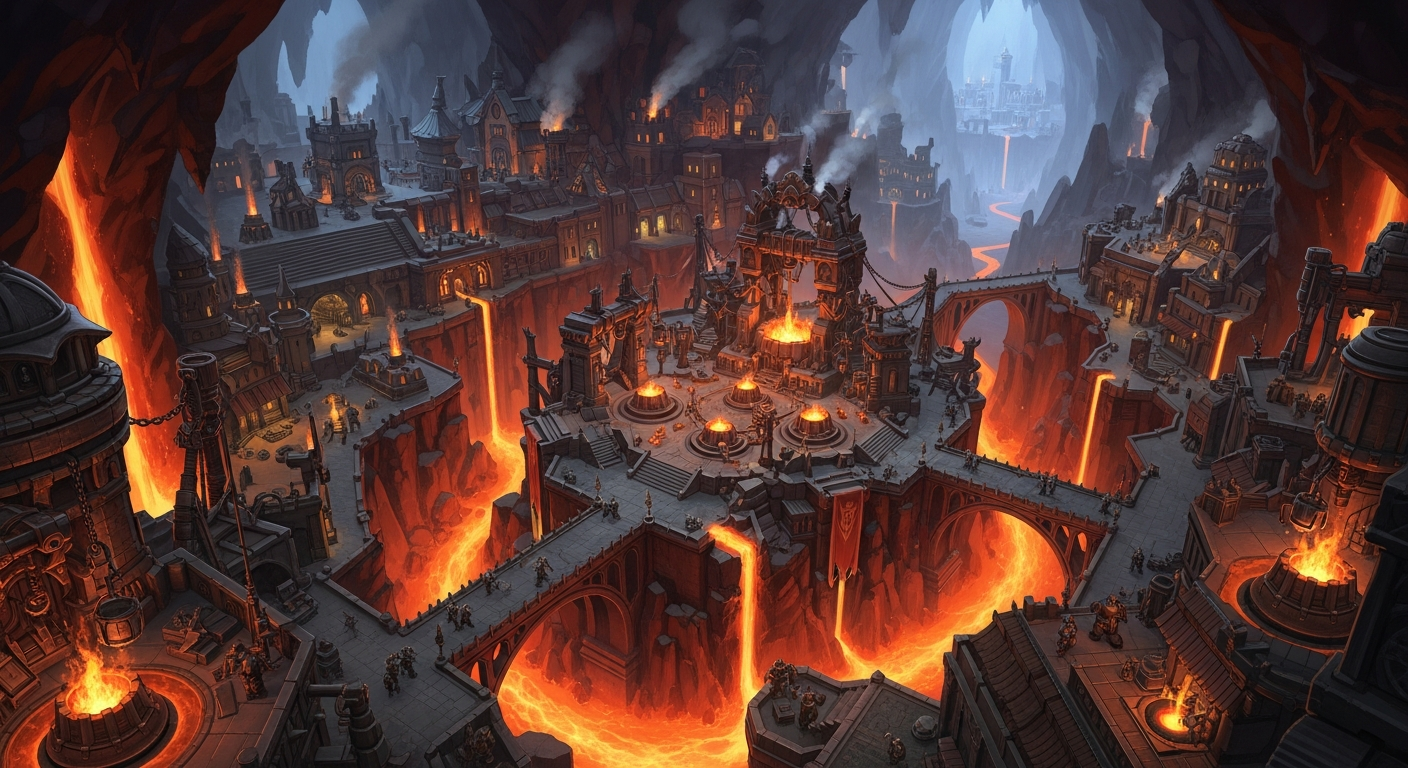
Khaldun Forgehold, the Heart of Hammer and Flame, is the dwarven forge-city of Eldurae, carved into the volcanic rock of the Emberpeak Mountains and veined with molten emberite that glows “like captured dawn.” It is ruled by the Embermantle Clan under Thane Durak Embermantle, whose authority is absolute yet rarely wielded with cruelty; daily life sits beneath the Great Guilds of Khaldun — the Smiths, the Miners, and the Rune-Smiths — into whose strict apprenticeship every Khaldun child is enrolled. Its industrial heart is the Everflame Forges, powered by emberite channels drawn from the Flame Below, the primordial force said to dream within the earth’s molten veins. Gear bearing the Rune of Khaldun maker’s mark commands triple the price in any city above; enchanted weapons are produced in the Runeworks, where runesmiths whisper binding and warding into hot steel before quenching it in blessed oil. Magic is tolerated only when it serves the forge or the city’s defence; rogue casters are silenced by the Flameguard, the city’s elite obsidian-steel-plated wardens. Beneath the lower mines stretches the Emberdeep, the deep tunnels where miners report voices warning of something vast stirring in the molten dark — whispers the dwarves of Khaldun choose to ignore. World-brief canon; the party has never visited. The one structural connection the campaign has to the city is Vasquez’s adoptive dwarven family — whose crest he re-engraved onto his Aurelian plate in s10 [2], L1841) — and the DM’s confirmation in s15 that he and Althea are “the only two that knows what this is, because they’re from Khaldun” [4].
Overview
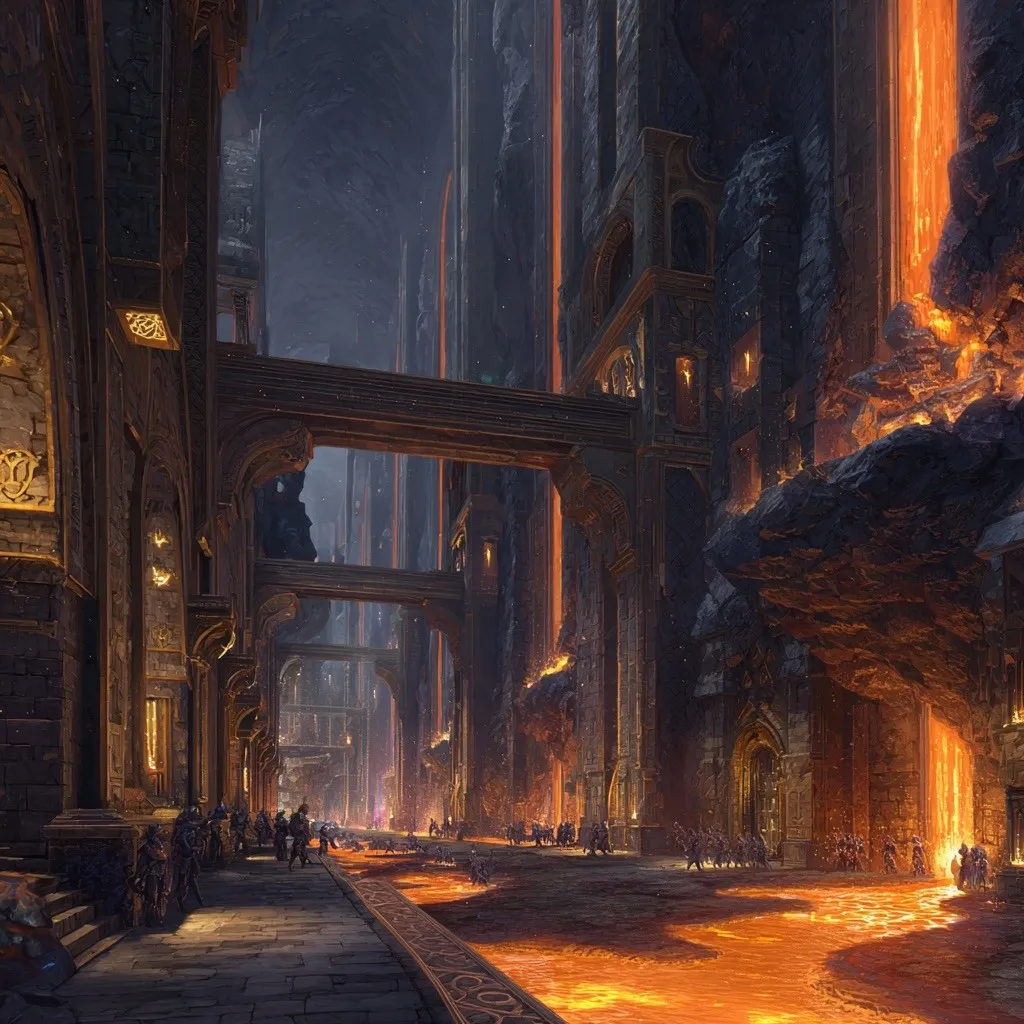
Khaldun Forgehold — the Heart of Hammer and Flame — lies deep within the Emberpeak Mountains, carved into volcanic rock veined with molten emberite that glows like captured dawn. It is one of the great powers of Eldurae in the pre-campaign world brief: a city-sized industrial cathedral of stone, fire, and rune-craft whose output sets the upper bound on weapon and armour quality across the continent. Massive stone columns rise into darkness, etched with glowing runes of warding and craft. The air is thick with heat, soot, and the ceaseless rhythm of hammers striking steel.
The city is dwarven, ruled by the Embermantle Clan under Thane Durak Embermantle, and structured beneath the Thane by three Great Guilds — the Smiths, the Miners, and the Rune-Smiths — whose fortress-halls govern daily life and into whose apprenticeship paths every Khaldun child is enrolled. The party has not visited and have not encountered any Khaldun-affiliated NPC on screen. Everything below is pre-campaign world-brief canon, supplemented by the one structural link the campaign has to the city: Vasquez’s adoptive dwarven family [1]; [2]; [3] and the DM’s s15 confirmation that he and Althea are “from Khaldun” [4].
Geography and appearance
Khaldun is inside a volcano, not on it. The city is hollowed out of the volcanic rock of the Emberpeak Mountains — a mountain belt whose lower veins run with molten emberite, the glowing mineral that powers everything Khaldun does. The world brief paints the place in two registers at once: the architectural (massive stone columns rising into darkness, runes glowing on every load-bearing surface) and the sensory (heat, soot, the ceaseless rhythm of hammers on steel).
The main halls are lined with the Everflame Forges, whose fires are continuous and sacred, fed directly by channels of molten emberite drawn from the Flame Below. Above and around the forges sit the guild fortresses — the Great Guilds of Khaldun’ halls — each towering “like a fortress within the city’s cavernous streets.” Beneath the lower mines, the city’s geography drops down into the Emberdeep, the deep-tunnel network where miners pursue emberite veins glowing with molten life.
Visually, the runes are the defining motif: warding-runes on the columns, craft-runes on the forge-mouths, heat-runes on the obsidian-steel plate the Flameguard wear, binding-runes whispered into hot steel in the Runeworks, and the maker’s-mark Rune of Khaldun stamped on every finished piece worthy of the city’s name.
Government and authority
The Thane
The city is ruled by the Embermantle Clan, led by Thane Durak Embermantle. The world brief is specific about the texture of his authority: it is absolute, but rarely wielded with cruelty. Durak is not a tyrant. He is a Thane in the old register — a clan-head whose word is final, whose verdicts bind, and whose restraint is read by the city as virtue rather than weakness. The clan and the city are functionally the same political unit at the top: Embermantle decisions are Khaldun decisions, and dissent against the Thane has no clean institutional channel.
For the campaign-level posture toward the party, see the Embermantle Clan page.
The Great Guilds
Beneath the Thane, daily life is governed by the Great Guilds of Khaldun — three fortress-orders whose halls tower like fortresses within the city’s cavernous streets:
- The Guild of Smiths — the producers; every Everflame forge runs under their charter.
- The Guild of Miners — the suppliers; emberite extraction, tunnel safety, the deep-shaft custom.
- The Guild of Rune-Smiths — the enchanters; the Runeworks and the binding craft are theirs.
The Guilds decide trade, resource allocation, and apprenticeship. The apprenticeship paths they administer are strict: every child must follow one. There is no civic role in Khaldun outside the Guilds. A Khaldun-born adult is, by definition, a Guild adult.
The Guilds sit under, not beside, the Thane. The world brief frames the relationship as governance-by-delegation: the Thane’s authority remains absolute, but the Guilds run the day-to-day, and the texture of normal Khaldun life is set by Guild custom rather than by direct Embermantle order.
Enforcement: the Flameguard
The Flameguard are the city’s elite warriors — obsidian-steel plate inscribed with runes of heat warding and flame manipulation, drawn from across the Guilds and answerable through the Thane. They are the standing security of Khaldun and the institution through which the city’s posture toward magic is enforced.
Khaldun’s policy on magic is functional rather than doctrinal: magic is tolerated only when it serves the forge or city defence. Rune-craft is celebrated because it serves the forge. Battlefield magic in service of Khaldun’s defence is permitted. Anything else — rogue casters, unaffiliated arcane practice, magic that competes with the Guilds’ enchantment monopoly — is silenced. The Flameguard are the institution that does the silencing.
The contrast with Aurelia’s Pure-Light arcane prohibition is sharp: Aurelia outlaws arcane magic on doctrinal grounds and treats every caster as a temptation toward corruption; Khaldun tolerates arcane magic precisely to the extent that it serves the city’s industry and defence. Khaldun’s restriction is utilitarian; Aurelia’s is theological.
Industry and craft
The Everflame Forges
The Everflame Forges are Khaldun’s industrial heart. Their fires are sacred and continuous, fed by channels of molten emberite drawn from the Flame Below. They are not single-master workshops in the surface tradition; they are city-scale halls lined along the main concourses, each forge cradled into the stone and run under Guild of Smiths charter.
The forges’ output is the basis for Khaldun’s reputation across Eldurae: their weapons and armour bear the Rune of Khaldun maker’s mark, and gear stamped with it commands triple the price in any city above. The reputation is treated by the world brief as commercially uncontested — there is no rival forge-city of equivalent standing in the brief — and the price multiplier is the campaign’s canonical statement of Khaldun craft’s market value.
The Runeworks
The Runeworks are Khaldun’s enchanted-weapon production hall, run by the Guild of Rune-Smiths. The world brief gives a single, dense sentence on method: runesmiths whisper secrets of binding and warding into hot steel before quenching them in blessed oil.
The phrase distinguishes Runework enchantment from arcane casting per se. The runesmiths’ work is craft-magic, integrated with smithing — bound to the steel and to the quench, not to a spell slot or a verbal-component flourish. This is consistent with Khaldun’s “magic in service of the forge” stance: the Runeworks are not a prohibited arcane site, they are a sanctioned industrial one.
Emberite, and the Rune
The mineral, the mark, and the city are one economic unit. Emberite glows like captured dawn, runs molten in the lower veins of the Emberpeak Mountains, and powers the Everflame Forges; the Rune of Khaldun stamps the output of those forges; that mark commands a triple price multiplier in any city above. The cycle is: extract emberite, fire the forges, produce the gear, stamp the rune, sell at the multiplier, fund the city.
The dwarves of Khaldun are described as confident in this cycle. The world brief closes on the line that as long as their oaths remain unbroken, the Everflame will never die.
The Emberdeep — what the dwarves choose to ignore
Beneath the lower mines, tunnels descend into the Emberdeep, where miners pursue emberite veins glowing with molten life. The world brief calls out one thing about the Emberdeep specifically: voices echo in those depths, warning of something vast stirring in the molten dark. The dwarves of Khaldun ignore these whispers. Their hammers ring on, confident in the cycle and the oaths.
This is the brief’s deliberately seeded foreshadowing for the city. The mechanism is not specified — whether the voices belong to the Flame Below itself, to whatever the Flame Below is dreaming of, or to something separate stirring in the same rock — is not stated. Whether the “vast stirring” is metaphor (a poetic figure for ordinary tectonic noise), a literal entity (a sleeping primordial, a buried god, a great wyrm), or a true revelation from a slumbering Flame Below is the kind of thing the brief is content to leave as an open thread. (See Flame Below for the lore on the underlying force; see also the Open Threads tracker.)
The dwarves’ institutional posture — ignore it, keep forging, trust the oaths — is itself a campaign-relevant fact. The brief flags it as a posture, not a verified judgement.
Visitors, trade, and magic
Khaldun is open to visitors in principle, but the welcome is conditional. The brief is explicit:
Visitors are welcome if they come with gold, contracts, and respect.
The three terms read as the city’s actual entry policy. Gold for the commercial reason — Khaldun trades. Contracts for the institutional reason — Khaldun is a Guild city and movement of goods and services runs through Guild paperwork. Respect for the political reason — Khaldun is a Thanate; the Thane’s authority and the Embermantle Clan’s seat are not subject to bargaining.
Magic, as above, is the constraint that overrides the welcome. A visitor whose practice serves the forge or the city’s defence has a place. A visitor whose practice does neither is at risk of the Flameguard.
In-campaign references
The city is not named in any transcript. Three transcript moments touch Khaldun through its only on-screen visual artefact (Vasquez’s re-engraved Aurelian plate crest) and one DM line places two PCs as Khaldun-natives.
Session 9 — Vasquez’s adopted-dwarf-father vision
In the Black Vein Quarry succubus-vision sequence, Vasquez described his greatest failure as a botched knife-mold he had tried to forge for his adopted father:
“The only greatest fail that he could feel… was more so a failure of a mold that he was trying to forge. something for a knife that he wanted to make to impress his adopted father. Didn’t really work out well. It shattered.” — Vasquez, [1]
The vision establishes the adoption, the dwarven-craft frame around Vasquez’s identity, and the campaign’s first oblique link to Khaldun-as-craft-city. The adoptive family’s clan and city are not named in transcript; the DM’s s15 line later places Vasquez as a Khaldun-native.
Session 10 — the Aurelian plate gets a Khaldun crest
After looting the Aurelian Plate Armour from the downed Aurelian Paladin, Vasquez used the long rest at Thomas Feld’s house to re-work the chest crest from the Aurelian sunburst to his adopted-dwarf-family sigil:
“…also put his uh family crest on there well his adopted family crest” — Vasquez (via Terry’s read-back), [2]
The DM closed the long rest with the cosmetic confirmation:
“However, it is still looking relatively Aurelian. You have changed the crest to look like your family crest.” — Nick (DM), [3]
The crest currently riding on Vasquez’s chestplate is therefore a Khaldun-adjacent dwarven family crest — functionally the only piece of Khaldun craft-culture the party is actively wearing.
Session 15 — “they’re from Khaldun”
In the s15 Aurelian-patrol fight, a recruit-tier Aurelian fired a flare into the air. The DM gated the meta-knowledge of what the flare meant:
“They’re the only two that knows what this is, because they’re from Khaldun.” — Nick (DM), [4]
The “two” are Vasquez and Althea. This is the campaign’s only direct DM-stamped statement that any PC is from Khaldun Forgehold and the closest the corpus has come to placing a character inside the city’s institutional life.
Session 19 — a Khaldun desert detour around Aurelia
Planning the route to Vel’Kris after abandoning the Aurelia raid, the DM floated Khaldun as the anchor of a southern detour that avoids Aurelian territory entirely:
“Now that you think about it, it might actually be smarter to completely avoid Aurelia and just go through Khaldun and all the way through Sabermoth.” — Nick (DM), [5]
Terry characterised the route in the city’s own terms — “trekking through a desert… we literally have to go through a volcano… some dragon worshipping crazy people” — softening “crazy people” to Dragonborn who are “just… pious” [6], a description consistent with Khaldun’s volcanic Emberpeak setting and dwarven/forge culture even as the players reached for “Dragonborn.” The detour was not taken this session; the party leaned toward the Eldwythe→Umbrafall→Mirestrand land road or a skiff instead. “Sabermoth” [5] is a new, unconfirmed place-name named only once by the DM as the leg after Khaldun; it does not yet have a page and may be a Whisper rendering of the existing Sablemar — flagged for reconciliation, not created.
Posture toward the party
Unknown / no on-screen interaction. The city is institutionally indifferent to the party — they have not visited, they have not made themselves known, and Khaldun has not made any move toward them. The structural questions an eventual Khaldun arc would have to answer:
- The party would arrive bearing two Khaldun-claimed members (per [4] and one piece of Khaldun-crested heavy plate (the Aurelian plate with Vasquez’s adoptive-family sigil) — but otherwise as outsiders.
- The party has three arcane-leaning members (Caelumn, Terry, Althea in her cleric/paladin register). The Flameguard’s “rogue casters are silenced” standing order is the operational constraint a Khaldun visit would have to navigate up front.
- The party has a commercial reason to engage — Rune of Khaldun-stamped weapons and Runework enchantments are the gear ceiling for the continent, and they are sitting on saleable loot.
- The party has a lore reason to engage — the Emberdeep’s “something vast stirring” thread is one of the world brief’s most explicit foreshadowing seeds, and a party member (Vasquez) is already host to one entity (Mharos) whose family of cosmic problems is the campaign’s main horror register.
Status as of session 16
Unvisited. Off-screen. Politically and economically dominant in the Emberpeak Mountains region; structurally connected to the party only by Vasquez’s adoptive family and Althea’s Khaldun origin per [4]. The party is currently sailing south toward White Lantern Shrine and ultimately Aurelia; the Emberpeaks are not the present trajectory. If a future arc swings the party toward the mountains, the city promotes from “world-brief locale” to “active faction in play.”
See also
- Emberpeak Mountains
- Embermantle Clan
- Thane Durak Embermantle
- Great Guilds of Khaldun
- Flameguard
- Everflame Forges
- Runeworks
- Emberdeep
- Emberite
- Rune of Khaldun
- Flame Below
- Vasquez
- Althea
- Aurelian Plate Armour with Nullstone Runes
- Eldurae - Faction Bible
References
- ^ Session 9, line 1104 — Vasquez's adopted-dwarf-father vision — establishes the campaign's only Khaldun-adjacent character link.
- ^ Session 10, line 1722 — Vasquez re-engraves the Aurelian plate with his adopted-dwarf-family crest.
- ^ Session 10, line 1841 — DM confirms "You have changed the crest to look like your family crest".
- ^ Session 15, line 211 — DM — "They're the only two that knows what this is, because they're from Khaldun" (re Vasquez and Althea).
- ^ Session 19, line 345 — DM floats a desert detour avoiding Aurelia: 'go through Khaldun and all the way through Sabermoth' to reach Vel'Kris ('Sabermoth' = new unconfirmed name, possibly Sablemar).
- ^ Session 19, line 349-354 — Terry frames the Khaldun detour as 'trekking through a desert... through a volcano... some dragon worshipping crazy people' (Dragonborn), corrected to 'pious'.