Everflame Forges
| Everflame Forges | |||||||||||||||||
| the Everflame Forges · the Everflame · Khaldun forges · the Khaldun forges · the main forge halls | |||||||||||||||||
 | |||||||||||||||||
| Location | |||||||||||||||||
| |||||||||||||||||
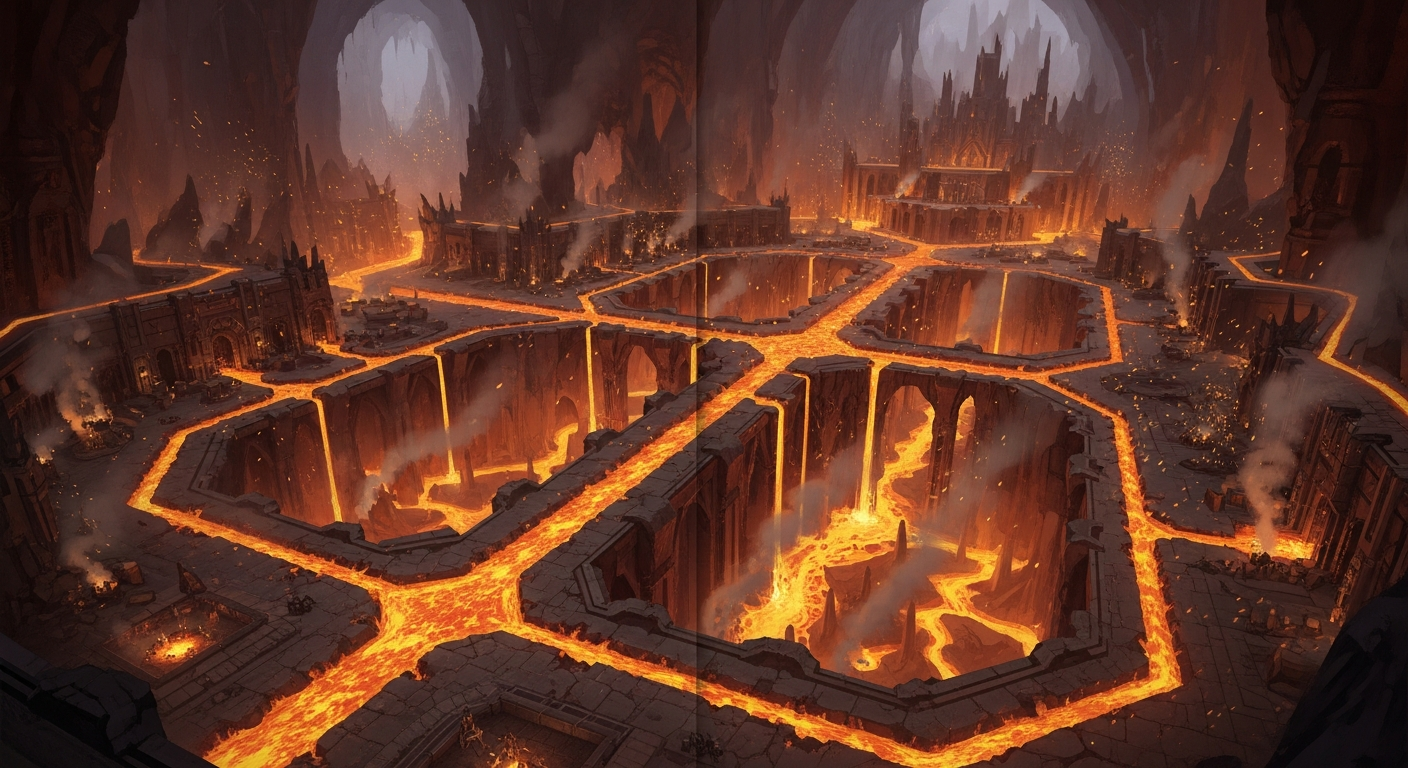
The Everflame Forges are the industrial heart of Khaldun Forgehold — the city-scale forge halls that line Khaldun’s main concourses, run under the Guild of Smiths’ charter within the Great Guilds of Khaldun, and feed every weapon and piece of armour bearing the Rune of Khaldun maker’s mark. Each forge is powered by channels of molten emberite drawn directly from the Flame Below, the primordial force said to dream within the earth’s molten veins. The forges’ fires are described in the world brief as sacred and continuous — they do not go out; the rhythm of hammers on emberite-fired steel is the city’s ceaseless soundtrack. Their output is the basis of Khaldun’s continental reputation: gear bearing the Rune commands triple the price in any city above. World-brief canon; the party has never visited.
Overview
The Everflame Forges are the industrial heart of Khaldun Forgehold. They are not a single forge or a single workshop; they are the city-scale forge halls that the world brief describes as lining the main concourses of Khaldun, each powered by channels of molten emberite drawn from the Flame Below.
Their place in the city is functional and symbolic at once. Functionally, they are the production halls whose output the Guild of Smiths turns into the Rune of Khaldun-stamped weapons and armour that command triple the price in any city above. Symbolically, the fires are sacred and continuous — they do not go out; the rhythm of hammers on emberite-fired steel is the world brief’s defining sensory image of the city.
The party has not visited Khaldun, has never seen the forges, and has no on-screen contact with the Guild of Smiths.
What they are
The brief is precise about two things and silent on most others:
- The forges are lined along the main halls of the city — they are an architectural feature of Khaldun’s central concourses, not tucked into back districts. Visitors walking the city see them.
- They are powered by channels of molten emberite drawn from the Flame Below. The fuel-and-fire mechanism is direct: emberite flows molten from below the city, through carved channels, into the forge-mouths. The fire is, in effect, the emberite itself.
The brief does not describe individual forge architecture, number of forges, master smiths, or the layout of the supporting workshops (cooling tanks, polishing benches, quenching stations). Some of these — particularly quenching — must exist (the Runeworks are described as quenching enchanted steel in blessed oil, which implies the broader Khaldun forge tradition has its own quench register).
Continuous and sacred
The world brief frames the Everflame’s continuity in two registers:
- Continuous in the practical sense: the fires do not go out. The channels run molten through the halls in steady supply, the forges fire on demand, and the ceaseless rhythm of hammers is what makes Khaldun audible from a distance.
- Sacred in the cultural sense: the Everflame is not just a fuel system, it is the city’s binding act. The brief’s closing image of Khaldun ties the forges directly to the city’s standing-oath cosmology: “as long as their oaths remain unbroken, the Everflame will never die.”
The two are coupled. The Everflame “never dying” is conditional on Khaldun’s oaths holding. What an oath-breaking would actually look like — and whether the Flame would gutter in a slow industrial sense or fail catastrophically in a sacred one — the brief does not say. The construction is deliberately load-bearing: the Forgehold is institutionally confident that the oaths hold and the Flame will not fail; the Emberdeep’s whispers are exactly the kind of thing the brief frames the dwarves as choosing not to hear.
Relationship to the Flame Below
The Everflame’s fuel is the Flame Below — the primordial force said to dream within the earth’s molten veins. The relationship is direct: the channels run molten emberite from the Flame Below to the forges. The forges’ fires are, in some sense, the surface expression of that source.
The world brief is theological-shaped on the Flame Below itself: whether it is metaphor, a deity, a primordial entity, or a purely geological force is unconfirmed (see Flame Below). But the Everflame Forges are the on-ground answer to “what does the Flame Below do for the city” — it powers the forges, and the forges build the gear, and the gear funds the city.
Output
The forges produce the Rune of Khaldun-stamped weapons and armour the city is famous for. The Guild of Smiths runs the forges under the Embermantle Clan’s authority; the Rune-Smiths take a subset of output into the Runeworks for enchantment. Every Khaldun-made enchanted weapon began as Everflame steel.
The price multiplier — triple in any city above — applies to the forges’ Rune-stamped output as a whole. Whether unstamped Everflame work also exists (apprentice pieces, internal-use tooling, the lowest tier of city goods) is unspecified. The brief implies the city’s consumer output is the Rune-stamped category; the Rune is what travels.
Posture toward the party
No interaction. If a future arc brings the party to Khaldun, the Everflame Forges are the most visible expression of what the city does and how. A commercial party would interact with the Guild of Smiths at the forges; a research-oriented party would be more interested in the Runeworks; a lore-oriented party would be more interested in the Emberdeep and the Flame Below. The forges are the front door to all three.
Status as of session 16
Active and off-screen. The fires continue, the hammers ring on, the gear leaves the city. No party member has stood inside a Khaldun forge.
See also
- Khaldun Forgehold
- Emberpeak Mountains
- Emberite
- Flame Below
- Rune of Khaldun
- Runeworks
- Emberdeep
- Embermantle Clan
- Great Guilds of Khaldun
- Flameguard
References
- ^ — DM world brief only; not yet appeared in any recap.