Eldurae - Faction Bible
Major powers of Eldurae
Detailed entries for the great powers and other notable polities of Eldurae. Each has its own dedicated article (linked below); this page is the consolidated reference and the canonical source for any detail that hasn’t been re-confirmed in a session yet.
Aurelia, the Shining Bastion of Purity
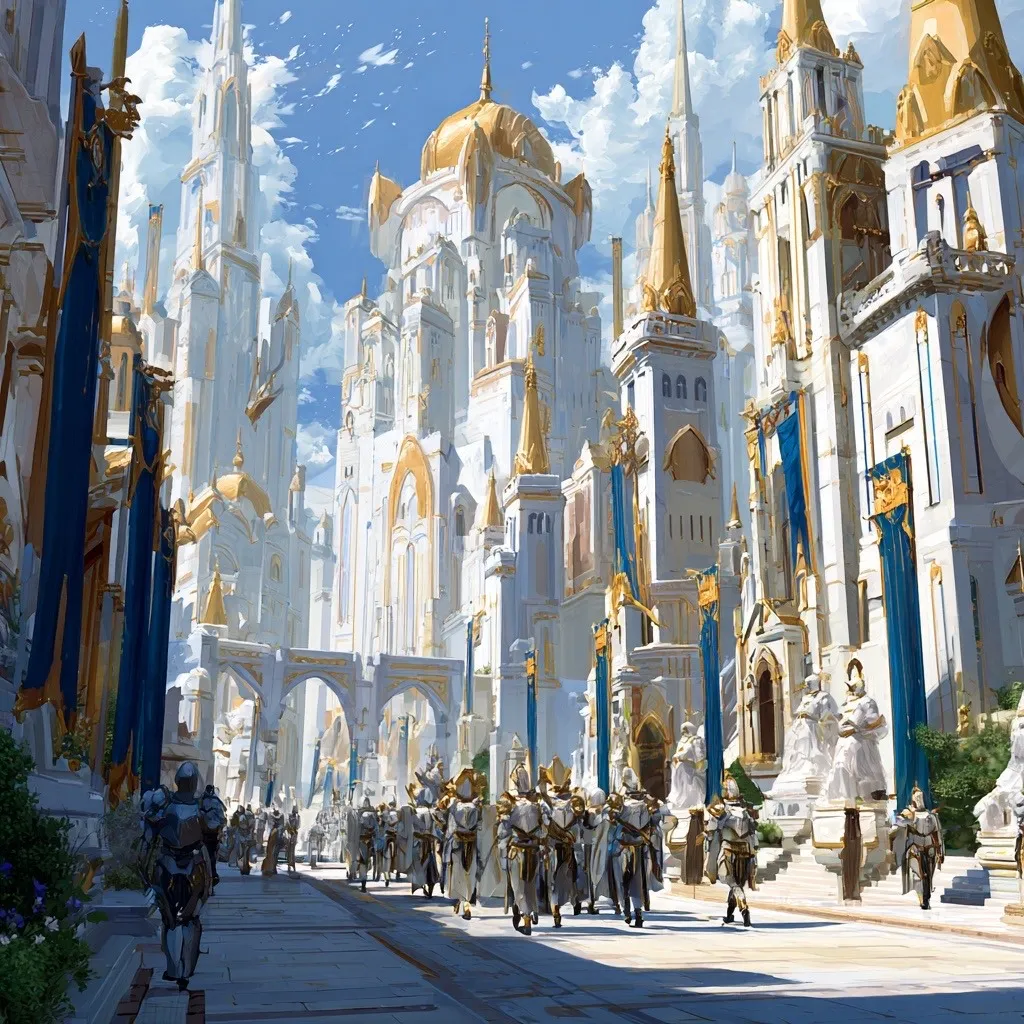
One of the greatest cities of Eldurae — a vast holy capital of white stone, golden spires, towering statues, and blazing braziers. Walls are immense, streets famously clean, order so exact that travellers speak of it with equal parts awe and caution. To its people, Aurelia is not merely powerful but proof that faith, discipline, and righteous rule can raise mortal civilisation above chaos.
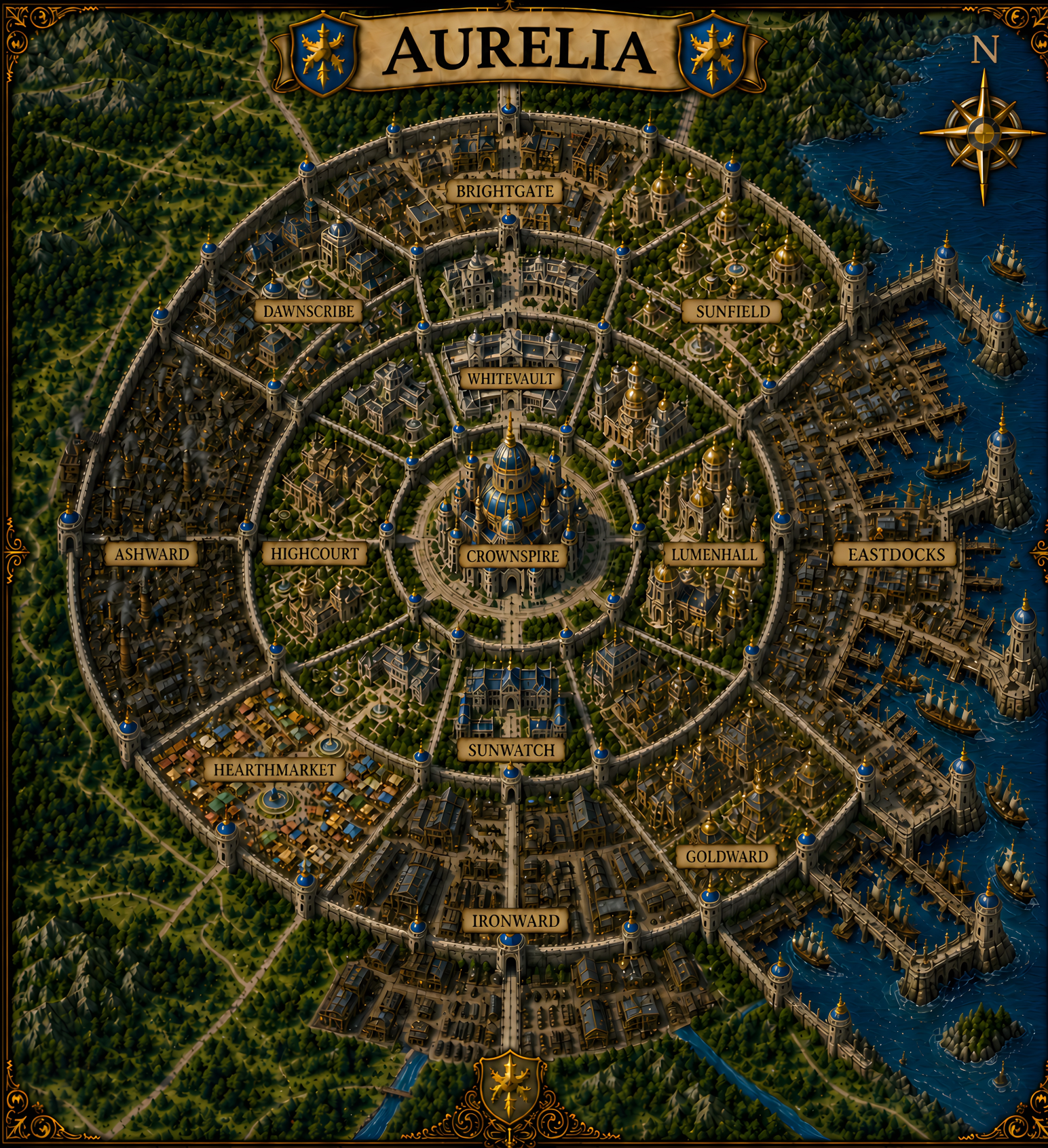
Built in broad rings, with status and privilege rising toward its radiant centre. At the outer edges lie the gates, docks, labour quarters, and military roads that keep the capital fed, guarded, and supplied. Farther inward, broad markets, workshops, schools, shrines, baths, and public halls support the life of the ordinary loyal citizen. Closer still stand the estates of noble families, high courts, elite compounds, and the grand institutions of church and state. At the heart of it all rises Crownspire, the palace-cathedral-fortress of the ruling power, enclosed within its own inner walls like a sacred city within the city.
Daily life: For most loyal citizens, life in Aurelia is stable and orderly — work, marriage, worship, trade, children, all under the guidance of the Church of the Pure Light and the protection of the city’s ever-watchful guard. Public rituals, school teachings, sermons, and civic tradition all reinforce the same belief: Aurelia stands between the world and corruption. Even the city’s poorest districts are not abandoned, but tightly managed, fed, and kept under firm supervision. To outsiders this can feel severe; to many citizens it feels like care.
Magic: Arcane magic is forbidden. The city’s buildings are raised from pale stone mixed with Nullstone, a rare mineral believed to shield the capital from dangerous sorcery and magical disaster — most citizens see this as one of Aurelia’s greatest blessings, a form of holy protection built into the very bones of the city. Divine magic is permitted only in service of the Pure Light. Priests teach that arcane power is a dangerous temptation, leading mortals toward arrogance, corruption, and ruin if left unchecked. Suspected arcanists are publicly arrested and formally investigated; what becomes of the guilty is the subject of rumour more than certainty — some say prison, some say exile, others claim the condemned are sent to labour far from the capital. In Aurelia, people tend not to ask too many questions once judgment has been passed.
Ruler: Seraphine, the sacred sovereign of Aurelia and living vessel of the goddess’s will. To the people she is both holy ruler and divine protector — a radiant figure in golden armour whose appearances at great public rites draw vast crowds in reverent silence. When she addresses the masses she speaks of purity, duty, vigilance, and the greatness of Aurelia’s calling. Tales of her battlefield might are told with near-religious awe, and many believe that if Seraphine herself takes the field, victory is already assured.
Enforcement: A single sacred order expressed in many forms — guards in the streets, soldiers on the walls, priests in the shrines, clerks in the record halls, and inquisitors charged with rooting out hidden threats. Patrols are common throughout the city, inspections are a normal part of public life, and scrutiny only sharpens closer to the centre. To the faithful, this is not tyranny but vigilance. Aurelia does not endure because it is kind. It endures because it is watchful.
Faith: Church of the Pure Light. Priests teach arcane power as a temptation toward arrogance, corruption, ruin.
Centre: At the city’s centre stands Crownspire, the gleaming palace-cathedral-fortress from which the city’s law, faith, and authority radiate outward. There, beneath sun-banners and shining towers, the will of Aurelia is given form in ritual, judgment, and steel.
Posture toward the party (in-campaign): Active antagonist by s15. Aurelian forces occupy Eldwythe and hunt the party. Confirmed encounters include the s10 Aurelian Paladin ambush in Umbrafall, the s14 occupation of Eldwythe with wanted posters of all five PCs, and the s15 chain-master execution of Ruin and theft of The Egg.
Arcanthys, the Floating Empire of Magic
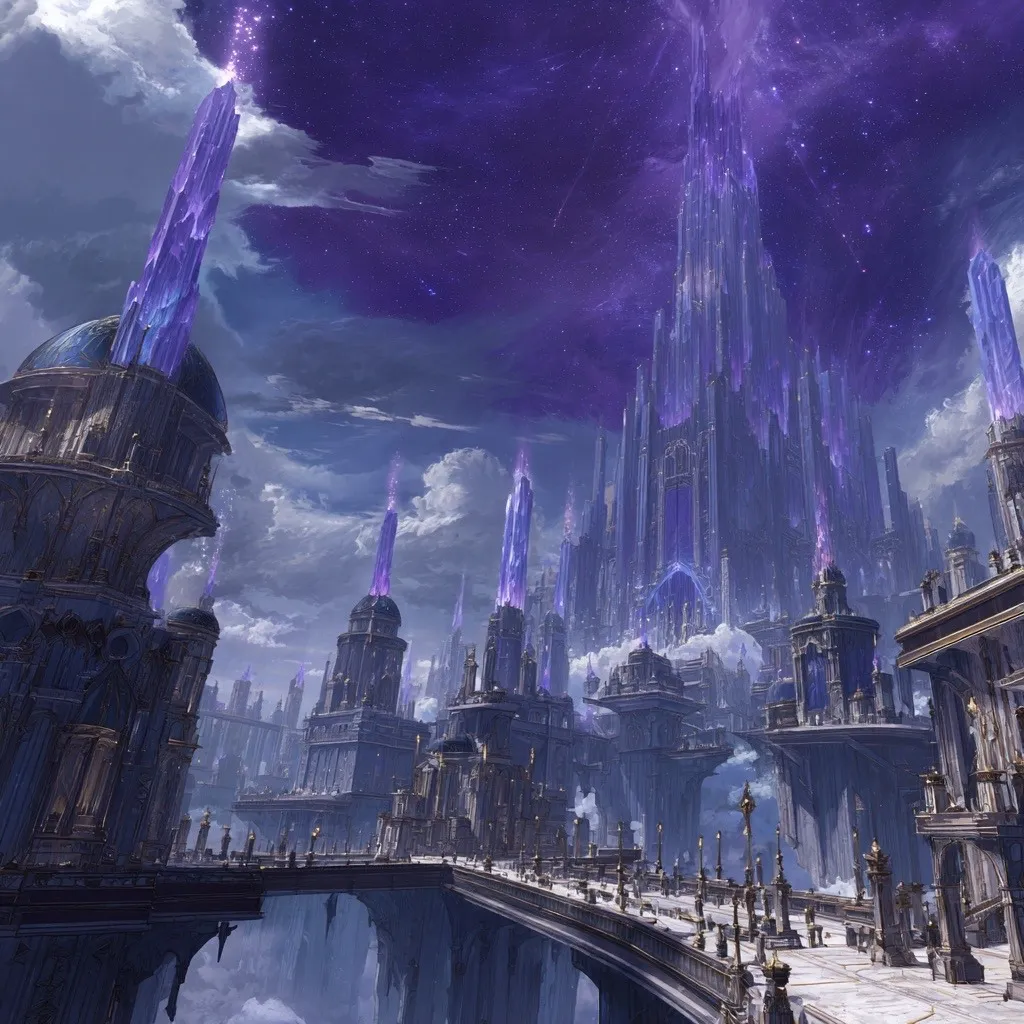
Arcanthys is the floating empire of magic — a city of marble platforms and crystal spires suspended high above the land by colossal enchanted chains anchored deep into the earth. Towers rise like glass needles into the clouds, etched with glowing runes that hum with leyline energy. Bridges of levitating stone drift between platforms, shifting at the whispered will of robed archmages.
Magic shapes every aspect of life. Streets ripple with shifting sigils, lanterns glow with bottled starlight, silent arcane constructs tend markets and carry burdens. Citizens believe they embody the height of civilisation — a society sculpted by pure mastery over reality itself. Those without magic are pitied and relegated to menial work beneath the city’s mage elite.
Conflict with Aurelia (the War of Fractured Heavens, 582-589 A.I.): Aurelia launched a crusade and sent its Nullstone Constructs — colossal divine war machines forged from black-veined Nullstone that suppresses magic — marching through Arcanthys’s arcane defences, immune to spells and unstoppable by force alone. Arcanthys responded by unleashing the Grand Conflux, warping reality to trap entire battalions in mirrored illusions and shifting streets. Stalemate. Destroying the Constructs risked collapsing Arcanthys’s floating platforms; Aurelia could not advance further without devastating losses. Both cities have held an uneasy peace since — each knowing war would mean mutual destruction.
Notable figures:
- Archmagister Vylarine Thael, custodian of the Grand Conflux. Cold brilliance; obsessed with transcending mortality into a being of pure arcane essence.
- High Seer Orlun Marr, blind prophet, guides the city’s future through cryptic leyline visions.
- Lessa Sunweave, Artisan of Sentient Threads. Crafts garments infused with living intellect, whispered to house her brother’s soul.
Heart: The Grand Conflux Spire, colossal nexus of crystal and adamantine that anchors the floating platforms and bends reality as its final defence. Within its mirrored halls, scholars study secrets said to grant power over time and space — knowledge that could one day lift Arcanthys beyond the mortal world forever.
Velkris, the Veiled Gate
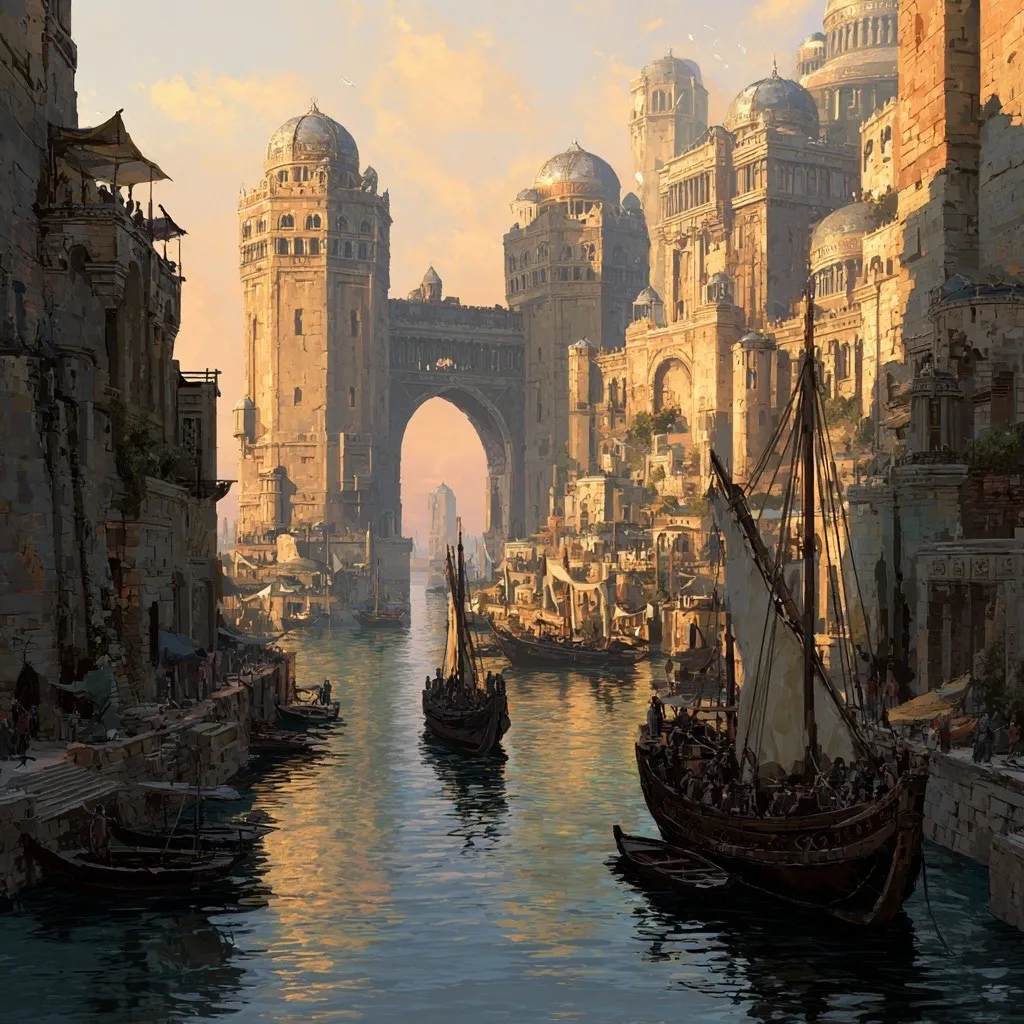
City at the mouth of the Greywater River, where the Sapphire Sea narrows into the only inland waterway for hundreds of miles. Stone towers flank the riverbanks, black-sailed patrol ships drift between them, heavy chains beneath the water rise to block ships that refuse inspection. The city’s old saying: “Everything has a price. The wise ask who pays it.”
Government: Council of Factors, five powerful merchant houses. They meet in the Silent Hall, deciding taxes, trade rights, and punishments behind closed marble doors. The five houses each dominate one major industry:
- House Brask — private force, mercenary contracts, debt enforcement. Factor: Tor Brask, scarred hobgoblin. “If Brask guards the door, someone paid for fear.”
- House Marr — the flesh trade (lower districts: slaves, debt-workers, sex slaves, labour pens; upper districts: bonded service, companionship houses, household placement, labour recovery). Factor: Lysa Marr, tiefling. “Marr always offers a way out. The price is the trap.”
- House Orlan — finance, debt, banking, contracts, arbitration, records. Factor: Iven Orlan, dwarven banker-lord. “Orlan does not forget. It only waits.”
- House Tallow — refined alchemy: medicine, perfume, contract wax, embalming oil, legal poisons, expensive inks, antidotes, preservation fluids, reagents. Factor: Sella Tallow, yuan-ti physician. “If Tallow made the cure, ask what else it treats.”
- House Vaunt — prestige, property, elite construction, civic beauty, old wealth. Factor: Elian Vaunt, sapphire dragonborn. “Vaunt does not destroy a street. It improves it until the old residents disappear.”
The Council does not rule by divine right, blood, or military conquest. It rules through debt, contracts, taxes, trade rights, private guards, public donations, court influence, ownership claims, political favours, and control of the city’s necessary industries. The factors do not call themselves kings. That would be vulgar.
Taxation:
- River Passage Levy, based on cargo weight and destination. Every ship pays.
- Current Tithe, fee for passing under Velkris’ watch (even barges just transiting).
- Breathing Tax, paid daily on goods stored in the city’s vast marble warehouses. “Even the air costs gold here.”
Enforcement: Order of the Veil, masked enforcers who patrol streets and canals. Ensure taxes are paid, magic is registered, debts are collected without question. House Brask handles private force where the Veil is too slow, too public, or too polite.
Records: The High Registry holds the documents that decide who owns what, who owes what, and whose claim is recognised. “A person with the right papers can enter, work, trade, inherit, borrow, own, sell, and leave. A person without papers can become a problem, a debt, or cargo.”
Public market: The Grand Exchange — a sprawl of plazas, covered markets, auction stages, moneychangers, food smoke, animal pens, pleasure houses, legal desks, gambling rooms, and shouting merchants. Almost anything can be bought somewhere in Velkris, if the buyer has coin, credit, or something worse to trade.
Faith: Temples to Myrana, Goddess of Coin and Contracts, double as banks and courts. Whispered deals in marble side-chapels decide the fate of families and entire trade routes. Foreign gods are tolerated. Strange ancestries walk openly in the markets. What matters is not purity, bloodline, or doctrine. What matters is payment.
Slavery and bonded service: Slavery exists in Velkris, though the wealthy rarely use the ugly word. They call it bonded service, debt labor, household placement, indenture, punishment contracts, or labor recovery. In the lower districts, people know what it is. In the upper districts, people prefer clean language. The institutional spine is House Marr; the enforcement is House Brask; the paperwork is the High Registry and House Orlan.
Underbelly: Drowned vaults beneath the city, rumoured to hold debtors who couldn’t pay — their names sealed in iron ledgers and their last possessions locked away until someone buys the debt. Some say older vaults still hold prisoners from forgotten trade wars, trapped in silence beneath the river stone. Others say the stories were invented by creditors to frighten children into paying what they owe.
Military doctrine: Never conquered. Armies that try find their generals bribed, supply lines poisoned, soldiers unpaid, or uprisings funded back home by Velkris’ gold.
Umbrafall, the City Beneath the Dead Sun
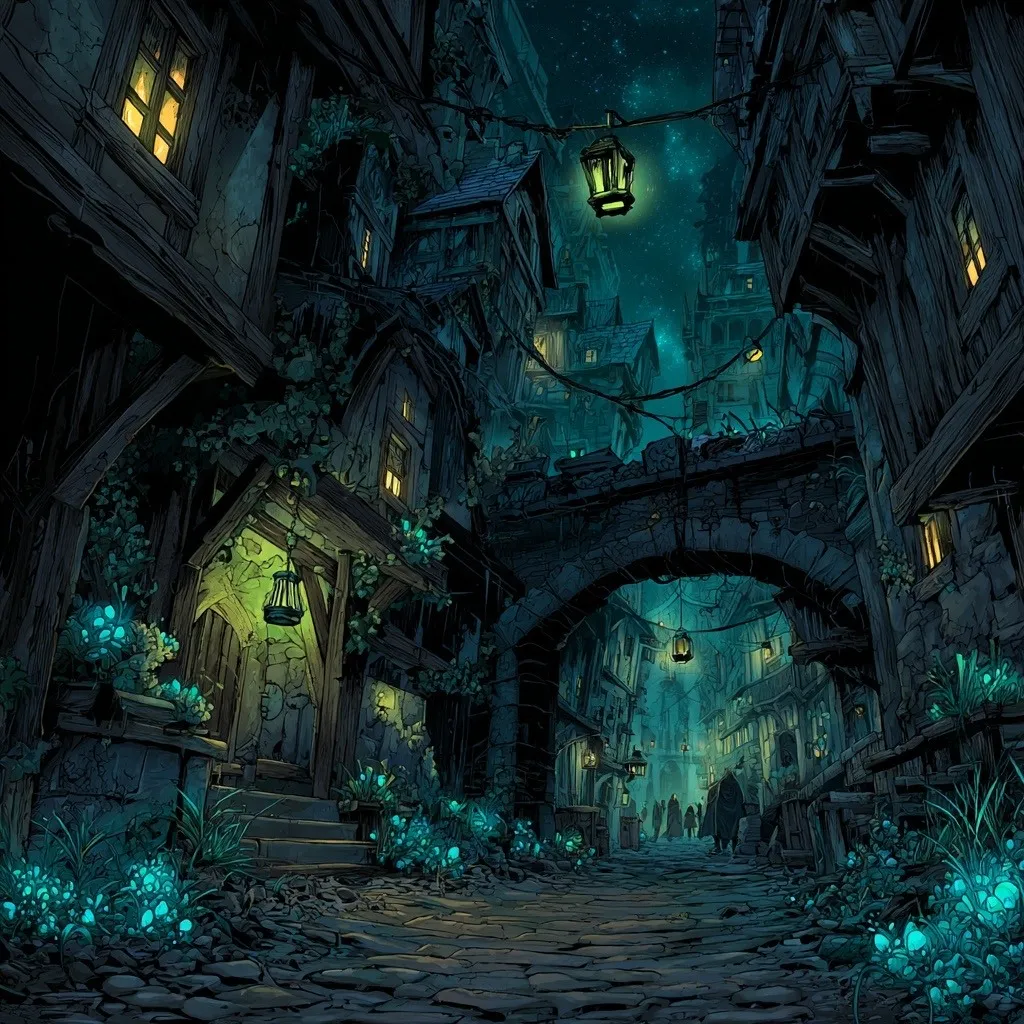
A city beneath eternal night. Fifty years ago this region was known as Luminara, a fertile breadbasket whose crops fed much of the land. That ended when a magical ritual meant to create lasting light failed catastrophically. The sky blackened, the fields died, and the old order fell apart. What rose from that ruin was Umbrafall. (Corpus dating tags this as the “Eclipse of Luminara, 793 A.I.”; the DM world brief gives only the “fifty years ago” framing.)
Now the city survives by turning its curse into profit. Its streets are wet, crooked, and dimly lit by lanterns and strange glowing flora. Bioluminescent fungi, mosses, and poisonous growths spread through the city in unnatural colours, harvested for toxins, reagents, potions, and darker trades. Umbrafall cannot feed itself well, so it buys what it needs and pays for it with what only Umbrafall can provide.
Known features:
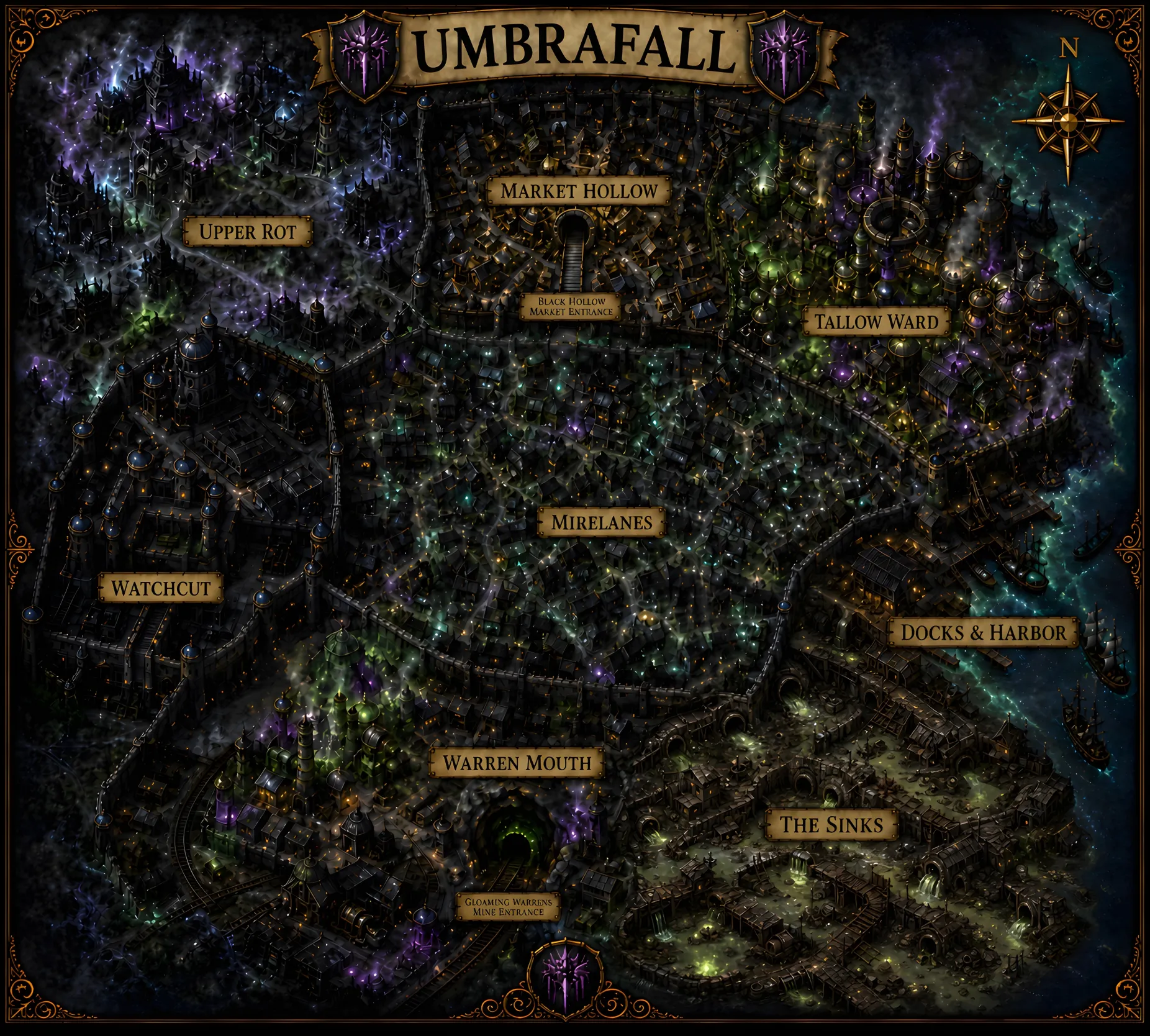
- Black Hollow Market, underground bazaar where almost anything can be bought.
- Gloaming Warrens, deep fungal workings that help keep the city alive.
- Nightwatch, the local enforcement; corrupt, feared, dangerous.
Government / power structures (per the DM): Umbrafall has no clean public government, but it does have real power structures: the Shade Mistress, The Broker, the Nightwatch, the Rat King (catalogued at The Rat), the Black Cartels, and other criminal/export powers.
Notable figures:
- The Shade Mistress, one of the city’s most powerful shadow figures.
- The Rat King (also called simply the Rat), whose spies are said to hear everything worth hearing.
- The Black Cartels, the city’s principal criminal/export combines.
Reputation: Umbrafall is not a place people trust. It is a place they use, fear, avoid, or vanish into. Some come for forbidden goods. Some come to hide. Some never get the chance to leave. In Umbrafall, secrets have value, suffering is ordinary, and the dark is just part of life.
In-campaign appearances: The party’s Umbrafall arc ran from session 4 to session 11 — The Broker’s Maelis Dirn contract (s4-s7), the Warrens dungeon crawl (s5-s7), the Black Vein Quarry mining job (s7-s10), and the Dawn Mercy Clinic / Aurelian conspiracy thread (s8-s10) all played out here.
Vhal’Zarim, Bastion of the Platinum Flame
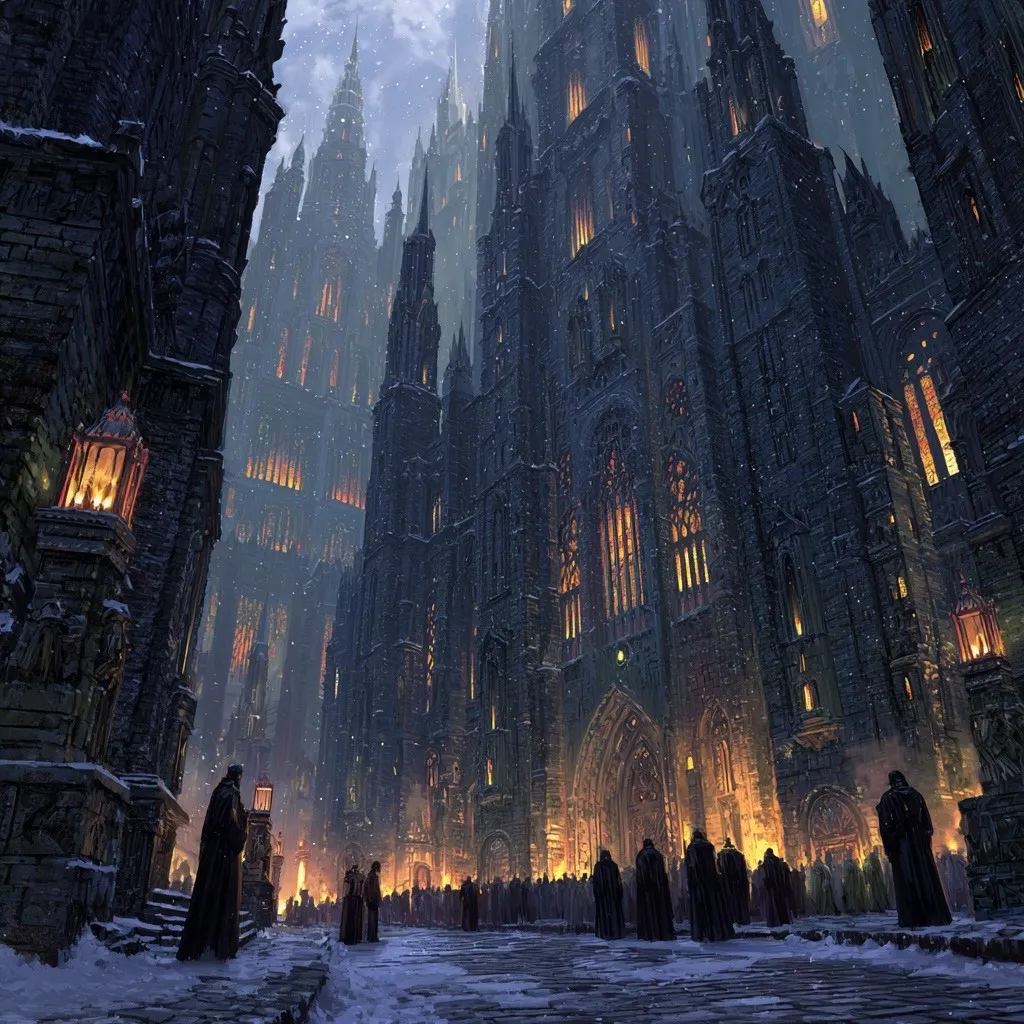
Vhal’Zarim is not a city — it is a cathedral carved into the bones of a dead empire. Black stone towers rise from scorched earth, spires clawing at the heavens like the remnants of a holy war. The air tastes of ash and incense. The silence is heavy not out of fear, but devotion; here even whispers are prayers.
Built in the crater where Karvos once stood. The faithful say Bahamut himself descended on Karvos after thirteen days of wrath from chromatic dragons, shielding the last survivors beneath his wings. What rose from the ruin was a covenant rather than a city.
Faith and law:
- Every citizen swears an oath to the Platinum Flame.
- Every soul is bound to the will of the Church.
- Day begins and ends with sanctified bells from the Sanctuary of Flame, the city’s immense central cathedral, where Bahamut’s eternal fire burns behind sealed doors.
- Magic exists only in service of the divine. Metallic-blooded sorcerers are exalted. Chromatic ones vanish. Arcane study is permitted, but only under the eye of the Platinum Order.
Reputation: Outsiders speak with awe and unease. No crime, no hunger, no chaos — but no freedom either. The people live in orderly devotion, eyes fixed on a god who once saved them and who they believe may one day return.
Posture toward the party (in-campaign): Off-screen but structurally hostile. Per Thomas Feld [1], Vhal’Zarim and Aurelia hunted the chromatic dragons together “to near extinction”, which is the campaign-level constraint on Sevryn’s The Egg Quest. Caelumn is from Vhal’Zarim and a rejected initiate of the Platinum Order [2].
Sablemar, the Dustbound Bazaar
A lawless sprawl in the desert sands. Forbidden relics, outlawed magic, dangerous truths bought and sold without question. No rulers; only customers.
(Pre-campaign brief did not include a deeper entry. To be filled in as the party encounters Sablemar, if they do.)
Khaldun Forgehold, the Heart of Hammer and Flame
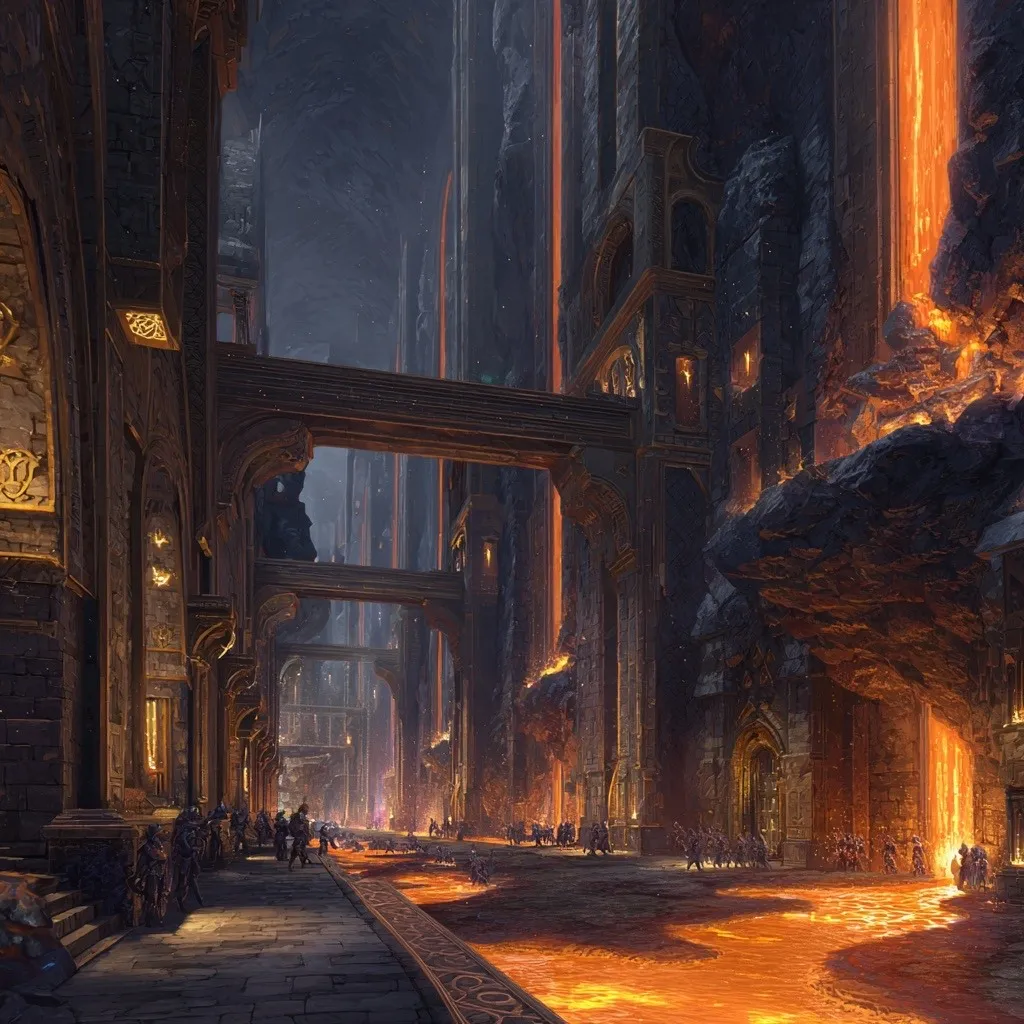
Khaldun Forgehold lies deep within the Emberpeak Mountains, carved into volcanic rock veined with molten emberite that glows like captured dawn. Massive stone columns rise into darkness, etched with glowing runes of warding and craft. The air is thick with heat, soot, and the ceaseless rhythm of hammers striking steel.
Government: The Embermantle Clan, led by Thane Durak Embermantle. His authority is absolute, yet rarely wielded with cruelty — a Thane in the old register whose word is final and whose restraint the city reads as virtue. Beneath the Thane sit the Great Guilds of Khaldun — the Smiths, the Miners, and the Rune-Smiths — whose fortress-halls tower within the city’s cavernous streets and whose decisions shape trade, resource allocation, and the strict apprenticeship paths every Khaldun child must follow. A Khaldun-born adult is, by definition, a Guild adult.
Industry:
- Everflame forges line the main halls, each powered by channels of molten emberite drawn from the Flame Below, a primordial force said to dream within the earth’s molten veins.
- Weapons and armour bearing the Rune of Khaldun maker’s mark command triple the price in any city above.
- The Runeworks produce enchanted weapons: runesmiths whisper secrets of binding and warding into hot steel before quenching them in blessed oil.
Enforcement: The Flameguard — elite warriors clad in obsidian-steel plate inscribed with runes of heat warding and flame manipulation. Magic is tolerated only in service of the forge or city defence; rogue casters are silenced.
Visitors: Welcome if they come with gold, contracts, and respect.
Mystery: Beneath the lower mines stretches the Emberdeep, the tunnel system where miners pursue emberite veins “glowing with molten life.” Rumours say voices echo in those depths, warning of something vast stirring in the molten dark. The dwarves of Khaldun ignore these whispers. Their hammers ring on, confident that as long as their oaths remain unbroken, the Everflame will never die. (Tracked as an open campaign thread; see Open Threads.)